

You can find a complete listing of all the articles on this site here. They are listed in reverse chronological order, and are all clickable links. Twenty-five articles are displayed per page, with the publication date included. To find older articles, click on the page numbers at the bottom.
To search the site by subject, topic, or name, you can use the “Search” function on the right sidebar.
_______________________________
-
Coping With The Loss Of A Child (Podcast)
In this podcast, we discuss a serious subject. A reader explains that his family has just lost a young child, and he is searching for advice on how to deal with this calamity. I offer some suggestions drawn from Plutarch’s letter of consolation to his wife on the death of his two-year-old daughter Timoxena. We…
-
A Heinous And Remorseless Maritime Killer
I first learned of the following story in a long-forgotten book of maritime lore entitled Unsolved Mysteries of Sea and Shore. Authored by Edward Snow, it was published in only one edition in 1963. As it is a difficult volume to procure, it will be useful for me to retell the tale here in abbreviated…
-
Coming August 2021: A New Translation Of “Tusculan Disputations”
In August 2021, a new and original translation of the full text of Cicero’s Tusculan Disputations will be published by Fortress of the Mind Publications. Nearly two years in the making, this is the first complete translation of Tusculan Disputations to appear in English since the 1920s, and the only one that is fully annotated…
-
Breakout From Britain
Gunther Plüschow, Germany’s legendary escape artist of the First World War, was born to a well-traveled family in Munich on February 8, 1886. He was taken by his family to Rome at an early age, and was fortunate to have grown up amid the Eternal City’s bustle, ruins, and excitement; it was there that he…
-
An Arabic Translation Of “Seven Pillars Of A Noble Youth”
Honorius, who manages a blog dealing with themes of history, virtue, and philosophy, has just published a beautiful Arabic translation of my essay, Seven Pillars of a Noble Youth. It is very much appreciated.
-
The Terrifying Wreck Of The “São João”
By the close of the fifteenth century, the maritime enterprise of Portugal had established a reliable network of trading routes from the Iberian peninsula to the Indian Ocean. These routes were won at great cost; we note the results of the budding Age of Exploration, but forget the fearsome human toll that this Age exacted. …
-
Escape From Fort Warren
Fort Warren is a pentagonal fortress located on Georges Island in Boston Harbor. Older reference works call the island “George’s Island,” while modern texts have removed the apostrophe; readers can decide for themselves which spelling is more authentic. The island’s fortress was one of the most solidly constructed and intimidating military installations of nineteenth century…
-
Illusions Of Fitness, Delusions Of Preparedness (Podcast)
In this podcast we talk about the need for true, well-rounded fitness. Some think that getting bulked up in the gym makes them “fit” and ready to take on the world. While this may produce the appearance of fitness, it remains an illusion.
-
The Mysterious Disappearance Of Captain Blakely And The “Wasp”
The premise of John Carpenter’s 1980 horror film The Fog is an intriguing one. In the 1800s, we are told, a Captain Blake and his crew were lured to their deaths by townspeople who had set up a false beacon near some coastal rocks. The ship was dashed against the rocks at night; Blake and…
-
The Incredible Survival Of Augustine Le Bourdais
The ability to survive is dependent on both a strong physical constitution and an unshakeable determination. While both of these ingredients are necessary, experience has shown that the will to live easily surpasses physical robustness in relative importance. He whose actions are in accordance with his nature, truly lives. Sir Thomas Browne was entirely correct…
-
The Astor Place Riot Of 1849: The Consequences Of Incitement
One of the strangest and deadliest riots in New York history took place on May 10, 1849 outside an opera house in Manhattan. Although its proximate cause—a jingoistic dispute between the egos of two actors—no longer commands our attention, the riot has many lessons to teach us today. For it was a combustible mixture of…
-
Jumping Ship In The South Pacific
In January of 1841 the twenty-two-year-old Herman Melville shipped aboard the whaler Acushnet for a multi-year cruise. He had many motivations for doing this. There was, in the first place, a desire to see the world and test himself against its challenges; then there was a need to escape the stultifying confines and restrictions of…
-
“The Black Russian”: Lessons Learned From A Fascinating Life (Podcast)
In this podcast we discuss Vladimir Alexandrov’s book The Black Russian, and what lessons we may conclude from it. Frederick Bruce Thomas was a black American businessman who made a fortune in czarist Russia in the early 1900s. His life is a fascinating one, and one that has much to teach us today.
-
Mind, Body, And Estate
The historian Edward Gibbon’s autobiography, entitled Memoirs of my Life and Writings (1796), contains the following passage:
-
The Attack On Firebase Mary Ann
Max Hastings’s excellent history, Vietnam: An Epic Tragedy, discusses one revealing engagement that took place between American and North Vietnamese forces in late March of 1971. This action—a ferocious assault on a remote firebase named Mary Ann—merits further reflection, I think, and we will give it its due here.
-
The Strange Case Of Dr. Winslow’s Heart
The New England regional author Edward Rowe Snow (1902—1982) related a strange and fascinating piece of Nantucket lore in his 1979 book Tales of Terror and Tragedy. Since the volume is long out of print, I will retell it here.
-
Small Twitter Account Gold: Tweet Reading 1
In this podcast, I read some of the recent great tweets I’ve noticed from small accounts on Twitter. Small Twitter accounts are a refreshing break from the contrived foolery of the mainstream blue-check accounts. They are an underappreciated gold mine of honesty, passion, and tortured grapplings with truth. Let’s give some credit where it is…
-
The Leadership Principles Of St. Benedict
If we are to understand the mind of early medieval man, we must attempt to place ourselves in his situation and circumstances. It is difficult for us, having been reared in an age of relative peace and prosperity, to grasp the degree to which Western Europe had succumbed to chaos, warfare, and barbarism after Roman…
-
Everything Is Fine, Until It Is Not
In 1917 there was published in Germany a book entitled Deductions from the World War (Folgerungen aus dem Weltkriege). It was an analysis of lessons learned from the previous four years of intense fighting, and its author was a man named Baron Hugo Von Freytag-Loringhoven. At the time he was a lieutenant-general, and he was…
-
Exploring Small Twitter Accounts (Podcast)
I’ve been exploring small Twitter accounts lately. And when I say “small,” I generally mean accounts that have less than 50 followers. You’d be surprised how much gold can be found hidden away in these accounts: they tend to be raw, honest, and unconcerned with saying the “right” thing. In this podcast, I discuss how…
-
Here Be Thy Grave
The Swiss orientalist and explorer Johann Ludwig Burckhardt crossed the cataracts of the Nile in 1813 and was intending to penetrate into the heart of unknown Nubia. Near a place called Jebel Lamoule, his Arab guide dismounted from his camel and approached the intrepid European; his intention was to practice on him a time-honored extortion…
-
Alive Today, Dead Tomorrow, Then Alive Again
The ancient Greek statesman and general Alcibiades once likened his career to the lives of the mythical half-brothers Castor and Pollux.[1] These two figures are together called the Dioscuri, and they are attended by many stories and fables, some of which are contradictory or ambiguous. According to myth, the Dioscuri are alive and dead on…
-
On The Tempests Of Misery
The Roman writer Aelian, in his Varia Historia (X.5) credits the following parable to Aesop the Phrygian, although I have never heard it mentioned in collections of his stories. He said that a pig squeals when it is touched by man for a good reason: it does not produce fur or milk for human use,…
-
On Why The Best Philosophers Are Men Of Action
The Roman writer Aelian, in his Varia Historia (III.44), conveys the following anecdote. Three young friends, he says, were traveling to Delphi in order to consult the oracle. Along the way, they lucklessly encountered some bandits. In the melee that followed, some of the robbers were killed.
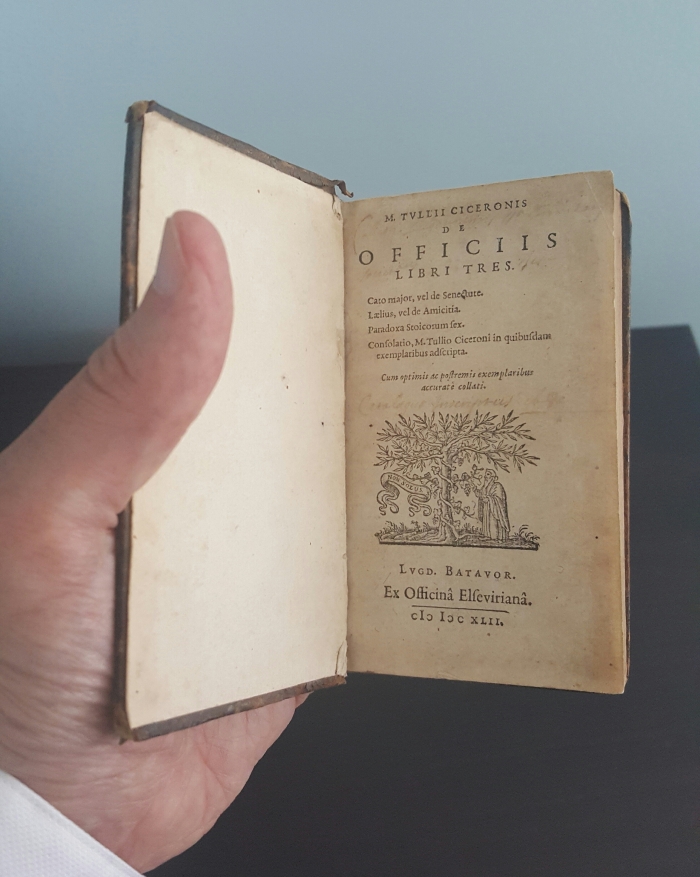
Original copy of Cicero’s De Officiis (On Duties) published in Holland in 1642. From the collection of Fortress of the Mind.
 Quintus Curtius
You must be logged in to post a comment.