

You can find a complete listing of all the articles on this site here. They are listed in reverse chronological order, and are all clickable links. Twenty-five articles are displayed per page, with the publication date included. To find older articles, click on the page numbers at the bottom.
To search the site by subject, topic, or name, you can use the “Search” function on the right sidebar.
_______________________________
-
Escape From Libby Prison (Part II)
As February 10, 1864 dawned at Libby Prison, the remaining inmates awaited the inevitable hurricane of outrage and disbelief that they knew was coming. All through the night, men had made their way through Col. Thomas Rose’s tunnel and out of Rat Hell to the dark streets of Richmond. Now they would have to face…
-
Escape From Libby Prison (Part I)
The greatest prison camp escape in American history took place at Libby Prison in Richmond, Virginia, in February 1864. On a cold winter night, 109 Union officers crawled through a suffocating, claustrophobic tunnel from a Confederate hell-hole to an empty lot near the building, and from there tried to make their way through hostile country…
-
The Mysterious Death Of Lord Kitchener
By 1916, the year of his death, Lord Horatio Kitchener had for years been a venerated and legendary figure throughout the British Empire. The campaigns in Gallipoli and Mesopotamia had dimmed some of his luster, but his name remained a revered one. The official announcement of his death thus came as a deep shock; and…
-
The Top 10 Articles Of 2021
It’s time to review the top ten articles and essays that have appeared here at Fortress of the Mind in 2021. The following list is ranked by page views, with the greatest number beginning at the top.
-
Obstacles And Pitfalls For The Youthful Student Of Philosophy
I was recently asked in correspondence to provide some thoughts on the pitfalls and obstacles to the study of philosophy. I have to admit that it was something of a relief to get this request, as it offers me a pretext to describe my own ideas on this subject. All of us seek a greater…
-
The Weird Tale Of Jenkins’s Ear
Governments looking for a pretext to justify a predetermined course of action will undoubtedly find one. Some outrage can be seized upon, some barbarity can be dangled before the public, or some looming danger can be created to whip up support for a policy. It is an ancient stratagem, and an effective one. A convincing…
-
“I’m Not Sure If She’s The Right One” (Podcast)
A young reader from Britain has a question about his relationship with his girlfriend. He wants something long-term, but has some nagging doubts as to whether his girlfriend is the right one. He’s not certain how to proceed. I read his email, and offer my thoughts.
-
The Complete G Manifesto Tweet Readings
Bookmark this page. In one place, you have links to every G Manifesto tweet reading. The first one was made in 2018, and the last in 2020. Since the G Man has deleted his Twitter account and blog, I consider these tweet readings to be an important part of the historical record on one of…
-
Epic Journey: Lord Roberts Marches From Kabul To Kandahar
The late 19th century saw an intense competition between the British and Russian empires for influence in central Asia. Once act of this “Great Game” was the Second Afghan War, which was fought between 1878 and 1880. Britain’s goals were two-fold: to keep tsarist forces out of Afghanistan, and to create a friendly buffer state…
-
A Fire Destroys H.M.S. “Bombay”
Fire both fascinates and terrifies man. It has nurtured man’s ascent from savagery to civilization by cooking his food, keeping him warm, and smelting his metals for war and agriculture; and yet nothing else so triggers his instincts of panic and terror when trapped in its presence. Fires in large buildings and aboard ships at…
-
Carry All By The Sword: Stephen Decatur Burns The “Philadelphia”
We have noted elsewhere that the young United States went to war against the Barbary principalities of northern Africa in 1801. President Jefferson found the continued payment of tribute to these piratical opportunists to be obnoxious, and resolved to punish the corsairs militarily. Tripoli returned the favor by declaring war on the Americans. Sword and…
-
The Gradual Slide Into Moral Corruption (Podcast)
In this podcast we discuss Alexandre Moratto’s 2021 film Seven Prisoners. The movie describes the experience of a young man named Matheus, who is basically sold into a modern form of industrial serfdom in Sao Paolo. He tries to rebel at first, but quickly learns the futility of resistance. But being ambitious, he gradually begins…
-
Memory Of The Fallen: The Work Of Fabian Ware
Continental Europe is dotted with serene and beautiful cemeteries from the First and Second World Wars. They are also found in the Dardanelles, holding the fallen of the Gallipoli campaign. They are ordered, serene, well-kept, and dignified with the solemnity that supreme sacrifice confers. Tourists now visit them frequently, strolling among the chiseled headstones that…
-
A Chivalric Duel Transcending Death: The “Constitution” Clashes With The “Java”
William Bainbridge ranks among the very greatest of the early American naval commanders. Born in Princeton, New Jersey in 1774 to a father who was a prominent physician, he was apprenticed to the sea at the ripe age of fifteen. Even as a teenager, his actions and deportment marked him as fated for great things.
-
Maneuvering Is Not A Substitute For Direct Action
Winston Churchill, like most statesmen, was known to have little patience for pettifoggery and pirouetting around a problem. His mind instinctively sought the core of a problem, and was able to slash through brambles and thickets to find it. His biographer William Manchester wrote, “[He] cared little for obtuse political or social theories; he was…
-
The “Tusculan Disputations” Audiobook Is Now Available
The audiobook of my translation of Cicero’s Tusculan Disputations is now available. Narrated smoothly and beautifully by Saethon Williams (the same narrator of my other translations), this audiobook is a complete and unabridged version of the print edition published in August 2021. Mr. Williams has brought his own authority, sparkle and polish to the dialogues,…
-
Increased Opportunities, Increased Temptations (Podcast)
When it comes to learning, were things better back in the 1980s and 1990s, or are they better now? How has the internet contributed to the “instant gratification” mentality? What are the parameters of the tension between the availability of resources, and the ease of gratifying our baser desires? We discuss.
-
The “Constitution” Escapes Certain Capture
The fabled USS Constitution is still the oldest commissioned vessel in the US Navy. Just the sight of her in Charlestown drydock is enough to quicken the pulse of any man entranced by feats of heroism and valor. A relic from an era when warships circled each other at sea like snarling dogs, she tallied…
-
All Opportunity For The Good, Yet None For The Unworthy
Philo of Alexandria wrote a relatively obscure essay entitled On the Prayers And Curses Uttered by Noah When He Became Sober. His translator has fortunately shortened this unwieldy title to the compact De Sobrietate, or On Sobriety. It contains the following passage of importance:
-
The New York City Doctors’ Riot
The grave of William Shakespeare is located in the Church of the Holy Trinity at Stratford-upon-Avon. Its epitaph contains this dire warning against those who would disturb his remains:
-
Never Mind What Others Think…What Do YOU Think? (Podcast)
Far too often, we base our opinions on what we absorb from others. But if you have done the homework, if you have done the heavy lifting, and if you know the material, you should have the confidence to form your own thoughts. People read your writings because they want to know what YOU think,…
-
Perry Captures The British Fleet At Lake Erie
A glance at a map of Lake Erie quickly reveals its strategic importance to the belligerents of the War of 1812. The lake sits atop what was then the western boundary of the United States. The British were in control of Canada; with the waters of Lake Erie at their disposal, they would be able…
-
The Defense Of The “General Armstrong”
Samuel Chester Reid was born in 1783 and first went to sea at the age of eleven. Various adventures, including time as a captured prisoner of the French at Basse-terre in the Carribbean, honed his resourceful instincts; and privateering seemed a logical choice of career. Upon the outbreak of the War of 1812, Reid assumed…
-
A Well-Timed Ruse: The “Peacock” Captures The “Epervier”
The naval actions of the War of 1812 are instructive for several reasons. These derive from the particular circumstances of the war, and from the nature of armed conflict in general. In the War of 1812, the United States was at a significant disadvantage to her British adversary; the British navy was the best in…
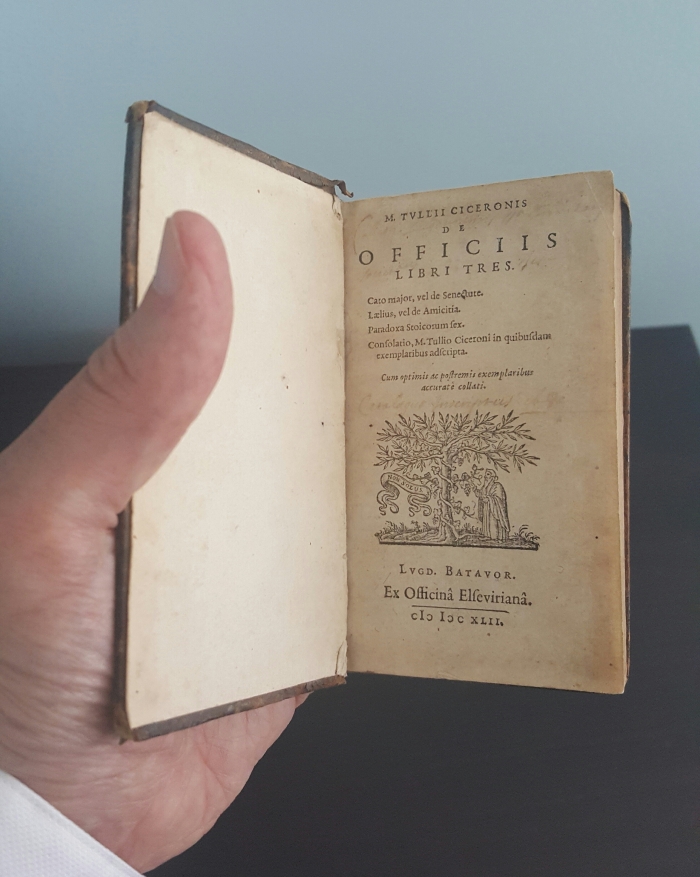
Original copy of Cicero’s De Officiis (On Duties) published in Holland in 1642. From the collection of Fortress of the Mind.


You must be logged in to post a comment.