

You can find a complete listing of all the articles on this site here. They are listed in reverse chronological order, and are all clickable links. Twenty-five articles are displayed per page, with the publication date included. To find older articles, click on the page numbers at the bottom.
To search the site by subject, topic, or name, you can use the “Search” function on the right sidebar.
_______________________________
-
The Positive And Negative Power Of Humiliation
In our perpetual quest for mastery over ourselves and our environment, we are often reminded that life can deal us hardships. The Chinese peasant has been wont to say that he must get used to “eating bitterness.” But what if there were a way to turn this to our advantage? What if there were a…
-
Talent Applied Consistently Is Never Wasted
The following parable is found in Aulus Gellius (XVI.19), who himself takes it from Herodotus (I.23). It reminds us that effort and talent, if applied consistently, will eventually reap rewards.
-
Arousing The Fighting Spirit In Your Men
The historian Sextus Julius Frontinus (c. 40-103 A.D.) wrote an interesting book called Stratagems (Strategamaton) which provides historical examples of various military ruses. It is actually a vast digest of historical examples that was meant to serve as a commander’s handbook of military advice. One of the chapters I was reading recently I wanted to…
-
Onde a história, a ciência e a biologia se cruzam (A Reader’s Translation)
A reader has translated one of my recent articles that was published here on June 7 (“Where History, Biology, And Religion Intersect“) into Portuguese for publication on his blog. I thought that was pretty cool. He sent me the link, and I wanted to share it. “Onde a história, a ciência e a biologia se…
-
Quintilian’s Guidelines For Boys’ Reading
The Roman rhetorician and teacher Quintilian (c. A.D. 35-100) is a rich source of tutelage for the student of proper speaking and writing. His Institutio Oratoria explores hundreds of subjects related to rhetoric and educational techniques. He remains a master of melioration. One section of his treatise (I.8) discusses guidelines related to reading habits for boys.…
-
The Roman Preparation Of Salt Pork
My most recent articles here have focused on a different type of subject matter than that which I normally write about. Change is refreshing. In recent weeks, I’ve had a lot of enjoyment going through the primary Latin works on agriculture and farming: these are Columella’s Res rustica, Cato’s De agricultura, and Varro’s De re…
-
Making Mead The Roman Way
This is Columella’s recipe for the alcoholic drink called mead; it is found in his Res rustica, XII.41. Mead is a fermented drink made from honey, to which may be added spices and other aromatics. Wines of various types as well as mead were the principal alcoholic drinks in the days of ancient Rome. Beer, although…
-
Ancient Methods Of Preserving Olives
We continue our perusal of Roman organic and agricultural practices. Columella (XII.49) give the following instructions for the preparation of olives. Basic Method 1. During September and October, while the olive harvest is ongoing, the bitter Pausean olive (acerba Pausea) can be harvested. 2. The olive should be crushed and soaked for a short time…
-
Ahab Contemplates The Head Of A Whale
There are moments in life for quiet contemplation. These are moments when we set aside our worldly cares, our tumescent and irritating thoughts, and contemplate the awesome Unknowable of what is in this world. Of all that has ever been, or is, or will be, we in our poor powers of comprehension will only know…
-
Ancient Roman Advice On Dog Grooming And Care
We will continue our excursions into Columella’s Res rustica with a summary of his advice on the buying, care, and grooming of dogs. In his day, as in ours, the dog was an essential animal to have on the farm. Besides companionship, it provided security and assisted in the management of other domesticated animals, such as…
-
How The Romans Collected Beehives In The Wild
Who Was Columella? In perusing forgotten volumes, we occasionally come across something of great interest. I had one such experience yesterday, and thought that writing about it would be a refreshing departure from some recent more serious fare. Sometimes learning should be frivolous.
-
Where History, Biology, And Religion Intersect
Some recent articles I’ve read have made me reflect on the interrelationship between religion, science, and history. How do they intersect, and how has one influenced the other?
-
The Wreck Of The “Medusa”: Ineptitude, Bad Leadership, And Tragedy
As part of the 1815 Peace of Paris settlement that ended the Napoleonic Wars, England agreed to cede to France some West African possessions near Gambia and Senegal. To implement this turnover, the French maritime authorities sent the vessel Medusa and three smaller ships to the Senegalese coast: these were named the Echo, the La…
-
The Country Of The Mind
He who inhabits the Country of the Mind takes ideas as his stock-in-trade. The inhabitant of this Country likes to read new works, to mull them over, to wrestle with their implications, and to gnaw on them in the same way that an eager puppy scrapes its growing teeth on a steakbone. And, after a…
-
Behind Everything Is The Unknowable
The never-ending debate between faith and reason, and between science and religion, leaves us more perplexed than ever. Explanations generate more questions than they answer. Behind every apparent certainty lies an inscrutable unknown. If we see science and religion as opposite poles, then perhaps we can begin to see the wisdom in Herbert Spencer’s assertion…
-
Turning Ill-Fortune Into Good Fortune: The Story Of Peter Mark Roget
I am almost finished with listening to the audiobook of Joshua Kendall’s The Man Who Made Lists: Love, Death, Madness, and the Creation of Roget’s Thesaurus. Kendall’s book is a biography of Peter Mark Roget, the British scholar-magus who created the classic reference work Roget’s Thesaurus. Here again it is proved that often the most…
-
How Two Readers Started Their Own Manufacturing Business
I enjoy receiving email from readers that describes how they overcame their challenges and personal difficulties. Sometimes readers also share their inspirational stories. I recently received some correspondence from a reader who described how he and a friend turned a lifelong passion into an actual business, and thought it would be something of general interest…
-
Celsus’s General Directives For Good Health
The most famous book of Roman medicine was the work entitled De medicina; the author’s full name was most likely Aulus Cornelius Celsus, and tradition has shortened this mouthful simply to Celsus. We know almost nothing of his life. The rhetorician Quintilian describes him as a learned man writing on a variety of subjects, including…
-
Philology Is A Weapon
Philology is the study of language as it is found in written historical sources. Words are dense repositories of historical information. Languages and inflections change subtly in morphology and syntax with the passing of years, and by being attuned to these changes, we can learn a great deal. Any native speaker of a language can…
-
The Rise And Fall Of Empires: Ibn Khaldun’s Theory Of Social Development
The most remarkable figure in medieval historiography was Abd al-Rahman Ibn Khaldun; his name in Arabic is أبو زيد عبد الرحمن بن محمد بن خلدون الحضرمي, but this is mercifully shortened to us simply as Ibn Khaldun. He was an urbane and well-traveled figure, whose life experiences taught him intimate lessons on both rulers and…
-
U.S. Grant’s Most Personal Victory
My article this week at Return Of Kings focuses on the little-known but inspiring story of Ulysses S. Grant’s race against the Reaper to complete his memoirs. I became familiar with the story after listening to the audiobook Grant’s Final Victory by Charles B. Flood, which outlines the drama in detail. Grant left the presidency in…
-
On Whether It Is Better To Criticize, Or To Remain Silent
The great Italian humanist Lorenzo Valla (1406-1457) took great pride in his constant need to attack his forebearers, as well as his contemporaries. Few escaped the wrathful attentions of his pen. Yet Valla saw himself as an upholder of the classical virtues, and for him, criticism was a form of moral duty. He said in…
-
Samuel B. Griffith: Warrior And Scholar
One of the more remarkable military men of recent history was Samuel B. Griffith (1906-1983). Born in Lewiston, Pennsylvania, he graduated from the U.S. Naval Academy in 1929 and was commissioned a second lieutenant in the U.S. Marine Corps. From 1931 to 1933, he served in Nicaragua with the American forces aiding that country’s Guardia…
-
The Practical Wisdom Of Thomas A Kempis
One of the most enlightening yet now underappreciated books of “personal improvement” is a small volume entitled The Imitation of Christ. It was written by an obscure cleric named Thomas a Kempis in the late medieval period in Germany. His name has various spellings, among them Thomas Von Kempen and Thomas Haemerkken.
-
The Worst Weapon Ever Made
The greed and callousness of combat weapons designers have resulted in the deaths of many men. Nowhere else has this fact been more starkly portrayed than in the story of what may be the worst small arm ever made, the Chauchat (also called the Fusil-Mitrailleur mle 1915, or the CSRG). It was a French light…
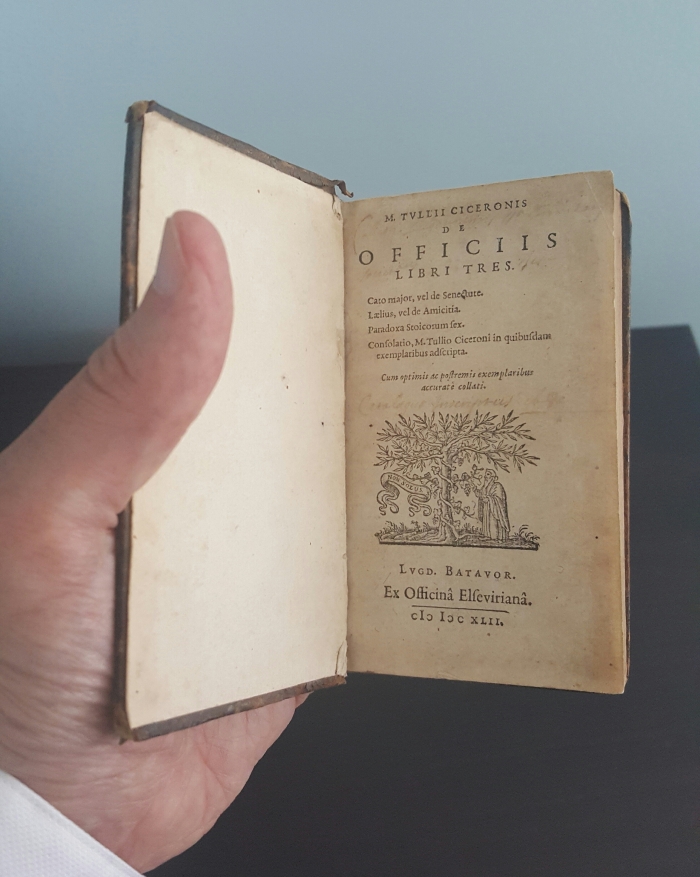
Original copy of Cicero’s De Officiis (On Duties) published in Holland in 1642. From the collection of Fortress of the Mind.
 Quintus Curtius
You must be logged in to post a comment.