
The Nightmare Wreck Of The “Nottingham Galley”

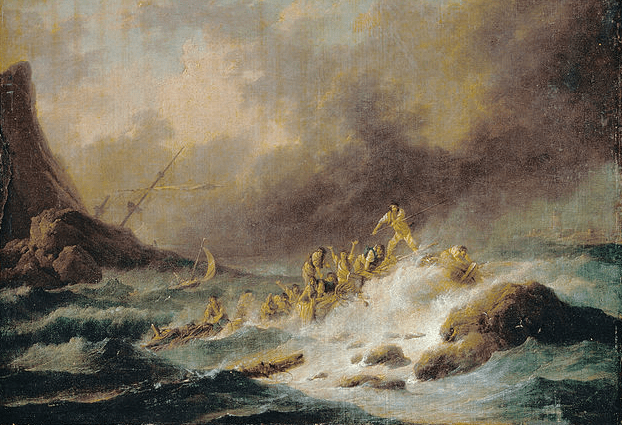
Would a captain deliberately wreck his own ship, or turn it over to privateers, in order to collect insurance money?  This is one of the central questions surrounding the strange and controversial story of the British merchant ship Nottingham Galley, which was wrecked off the coast of Maine in December of 1710.  It is a dark and compelling incident, one which will invite readers to draw their own conclusions as to what actually happened.

Continue reading

Into A Dark Forest

In very ancient times there was a dense, feared, and trackless forest that separated the territory of Rome from that of Etruria.  It was called the Ciminian Forest (Silva Ciminia), and it was a region that the Romans avoided. 

Continue reading

Anecdotes Related To Ya’qub Ibn Al-Laith Al-Saffar, Founder Of The Saffarid Dynasty

Ya’qub Ibn Al-Laith Al-Saffar was the founder of the Saffarid Dynasty of Sistan.  He lived from A.D. 840 to 879, and rose from humble origins in Afghanistan to conquer an immense area comprising parts of Iran, Afghanistan, Turkmenistan, Tajikistan, and Uzbekistan. 

Continue reading

The Bixby Letter

Those who have seen the movie Saving Private Ryan (1998) will recall a scene where the actor playing General George Marshall reads to his staff an eloquent and moving letter of condolence written by President Abraham Lincoln to a Mrs. Lydia A. Bixby during the Civil War.  This justly famous epistle, now known as the Bixby Letter, is reproduced below.  Who will protest at our quoting it in full here? 

Continue reading

Gratitude Links To Attitude (Podcast)

Gratitude is what determines our attitude and outlook on life. When we are imbued with a sense of thankfulness, when we look at the world from this perspective, doors open up for us. But if we see everything from a negative, grievance perspective, then we are unable to make progress–and in fact go backwards. We discuss an example.

Continue reading

The Leadership Of Captain Thrupp

Tales of superlative leadership abound in naval history. Through the study of historical examples, we are instructed in the qualities and characteristics of proper command. In early 1871 the British Admiralty sent a detachment of soldiers and marines to Australia aboard the iron screw frigate Megaera.  The ship carried 42 officers, 44 marines, 180 seamen, and 67 boys, for a total of 333.  After stopping briefly at the Cape of Good Hope, the Megaera embarked on the long journey across the Indian Ocean to Sydney.  It was anticipated that the vessel would reach its destination by July 5. 

Continue reading

The Object Of Unceasing Pursuit

One of Poe’s lesser-known stories, The Domain of Arnheim, seems to offer his theory of aesthetics.  I say “seems to,” because the dream-like quality of the story leaves the reader with more than a residue of ambiguity.

Continue reading

The Delusion Of Indispensability

More futility than nobility is found in the wars of the emperor Justinian.  His capable general Belisarius reconquered Africa and Italy, humbling the strutting pride of the Vandals and Goths; but these fugacious victories only hastened the West’s final ruin.

Continue reading

Your Own Lying Eyes

Edgar Allan Poe’s short story The Sphinx is not one that readers may be immediately familiar with.  Despite having been composed in 1850, its lesson resonates powerfully in the age of social media and unrelenting news cycles.

Continue reading

The Necessity Of Unity And Cohesion

In 1870 an obscure French army officer and military theorist named Charles Jean Jacques Joseph Ardant du Picq died from wounds he received during an engagement of the Franco-Prussian War.

Continue reading