
Ancient Treatment For The Common Cold

cold2

In a recent article we discussed Celsus’s ideas on treatment for depression and melancholy.  We now look at his prescription for dealing with the common cold, an ailment that until this day has defied a consistent cure.  What is interesting about his treatment suggestions is that they seem to be about as effective as anyone could give a cold sufferer today.  Judge for yourself.  The following information is taken from his De Medicina (IV.5).

Continue reading →

The Wisdom And Judgment Of Ibn Abi Duwad

qadi1

Ibn Abi Duwad was a judge (القاضي) who was born in Basra around A.D. 776.  He lived during the reign of the eighth Abbasid caliph Al-Mu’tasim.  An Arabic historian relates the following wise sayings of his, along with an amusing anecdote.  We will relate them here.

Continue reading →

Sunday Film Roundup (10/16/2016)

film2

And here.  We.  Go.

Cold In July (2014)

Director:  Jim Mickle

Southern gothic is alive and well in this independent, seedy little crime drama.  It’s a throwback to the great B-films of the 1970s, and well worth watching of this sort of thing is your bag.  This movie is a good companion film to No Country For Old Men, in that both take place in 1980s Texas.

Continue reading →

Ancient Treatment For Depression And Melancholia

depress1

What did the ancients think about depression, and how to cure it?  We will look at the views of Celsus, who wrote the most complete medical guide that has survived from Roman times (excluding the writings of Galen).

Continue reading →

The Courage Of Andreas

andreas2

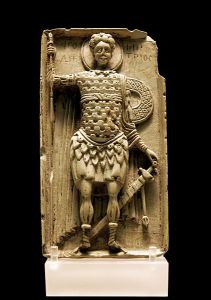
In the year 530 the Eastern Roman (i.e., Byzantine) Empire was engaged in a limited frontier war with its traditional enemy, the Sassanid Persians.  The two great empires had a long history of border clashes, as each constantly was testing the resolution of the other.  One of the engagements that took place in this year was the Battle of Dara, and it was fought in what is now eastern Georgia in the Caucasus mountains.

Continue reading →

The Dragunov Sniper Rifle (SVD)

drag3

Those who follow the war in Syria on YouTube or Twitter will likely be familiar with the unique profile of the Soviet sniper rifle officially known as the SVD (Samozariyadnyia Vintokvka Dragunova). Unofficially, of course, it goes by the name Dragunov.  The weapon has a long record of reliable service, having first appeared in 1963.  It has seen action in every conflict in which the Soviet Union, Russia, and her allies have been involved since that time.  In Syria, it has seen use all over the theater of conflict, in both urban settings and in the countryside.

Continue reading →

Sunday Film Roundup (10/9/2016)

film2

Here’s what the cat brought in this week.  I’ve got two movies to talk about this week, and both of them are worth seeing.  This doesn’t happen very often, so I’m grateful.

Continue reading →

Fear Or Love? The Views Of Cicero And Machiavelli (Podcast)

fear

Is it better to be feared or loved?  This famous question is more nuanced than people think, and was addressed specifically by Cicero in “On Duties” as well as by Machiavelli in his “Prince” and “Discourses.”  Yet there has been much oversimplification and misunderstanding on this subject.
We also discuss whether Stoicism lends itself to passivity and fatalism.

Continue reading →

The Pearl Of Peroz

pearl

Peroz I (or Pirouz) was a Persian king who wore the royal diadem from about A.D. 459 to 484.  The Greek historian Procopius (I.4.18) relates a great fable about him and his pearl, which we will reproduce here.  As is often the case with these enchanting old tales, the reader will be asked to suspend his credulity as to the fable’s literal truth, while being mindful of its deeper purpose as a moral exemplar.

Continue reading →