You Will Have Your Wilderness Years: The Case Of Frank Sinatra

sinatra

Sometimes the time is not right for your message to be heard.  Sometimes being great is not enough.  The right stars must come into alignment.  External conditions must be right for your message to be heard.  People may like you, but the real recognition may not yet be forthcoming.

History is replete with figures who went not just through slumps, but years of practical exile or relegation to obscurity.  But eventually, talent and quality will tell.  The key is to endure the hardship of the Wilderness Years.

Continue reading

How Einstein’s Thought Process Worked

I’m almost finished with Walter Isaacson’s excellent biography Einstein: His Life and Universe.  It constructs a comprehensive profile of the man, his work, and his thought process.  What many readers will want to know is:  how did he manage to think so creatively?  What can I learn from the life and work of this sort of great man?  I share Plutarch’s consuming interest in wanting to know why great men do the things they do.

Continue reading

Archimedes, The Sand-Reckoner

arch1

The greatest of all ancient scientists, and the only one fit to stand shoulder-to-shoulder with Newton, Galileo, and Einstein, was born in Syracuse, Sicily, around 287 B.C.  He happened to be the son of an astronomer named Pheidias; and perhaps this fact played some role in the selection of his career.  He moved to Alexandria after completing his schooling in Greek Sicily, for Alexandria was in those days the Mediterranean world’s capital of learning.

Continue reading

Aldus Manutius: The First Great Publisher In History

book2

We take so much for granted today about printed books.  The wisdom of the ages can be captured and preserved for costs that are so low as to almost negligible.  Save for the surfeit of information that currently exists, the modern man has no excuse not to be reasonably acquainted with his heritage.

It was not always so.  Before the advent of the printing press, books circulated in manuscript form.  They had to be copied by hand, and this was laborious and costly.  In the ancient world, manuscript books were relatively cheap and plentiful; but papyrus became unavailable from Egypt during the Middle Ages, leaving expensive vellum as the only available medium for “mass” writing.

Continue reading

The Luckiest Man On The Face Of The Earth

crown1

I have a close friend who knows a great deal about the game of baseball.  I always defer to his knowledge in discussions of the sport.  We were recently talking about the relative merits of modern ball players when compared to the great figures of earlier generations.  It is a debate that has no end, of course, but it is still entertaining.

Continue reading

Simon Murray: Legionnaire

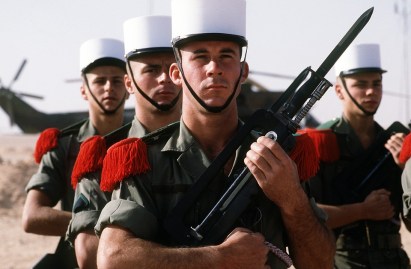
I have recently finished reading Simon Murray’s memoir of his life in the French Foreign Legion, which is titled simply Legionnaire: Five Years in the French Foreign Legion.  First published in 1978, it was recently reissued in 2006 as a mass market paperback.

Continue reading

Justinian’s Codification Of The Law

law1

Great men make laws, and greater men interpret them.

If a leader wishes to achieve immortality, let him organize, arrange, and codify a body of law for his people.  Many of the greatest leaders (Numa Pompilia, Lycurgus, Solon, etc.) have been lawgivers.  The monuments of stone have crumbled, but the laws remain.

To codify is to bestow immortality.

Continue reading

The Fall Of Queen Amalasuntha

anxiety1

Here is a good story of palace intrigue and conspiracy.  We turn our attention to late antiquity, to the Ostrogothic kingdom in Italy.

Amalasuntha (c. 495-535) was the daughter of Ostrogothic King Theoderic the Great.  When Theoderic died, his grandson Athalaric nominally became king.  But being a child, the real power lay with his mother Amalasuntha, who ruled as regent.

Continue reading

The Scheming And Ruthless Antonina

In a previous article here we recounted the dramatic fall of one of the Emperor Justinian’s venal officials, John of Cappadocia.  The key roles of this drama were the Empress Theodora and her amoral compatriot Antonina (c. 484-565), the wife of Belisarius.  It is now time to relate yet more adventures of this depraved yet admittedly fascinating figure.  Almost all of what we know about her and her unscrupulous maneuverings comes from the historian Procopius, whose Secret History (Anecdota) is a scorching indictment of Justinian, Theodora, and their court.  He is not an impartial source; and he seems to have been a snubbed official who revenged himself on the court by chronicling their indiscretions for posterity.  Yet there is some truth to his accounts, and his is not a voice that can easily be dismissed.

Continue reading

Michael Collins: The Irish Prophet Of Urban Guerrilla Warfare

Few figures in the history of guerrilla warfare have been as influential and successful as Michael Collins (1890-1922), the Irish revolutionary leader.  His tactical and strategic mastery of urban guerrilla techniques showed what a determined minority could do against an oppressive system of domination.  His career is said to have been studied carefully by such widely disparate figures as Mao Zedong and Yitzak Shamir.

He was born on October 12, 1890 in County Cork, Ireland, as the youngest of eight children.  The Ireland into which he was born was subject to direct British rule.  But Irish nationalism was in his blood: his father’s family had had connections with the Irish Republican Brotherhood, and he imbibed from this well as a youth.

Continue reading