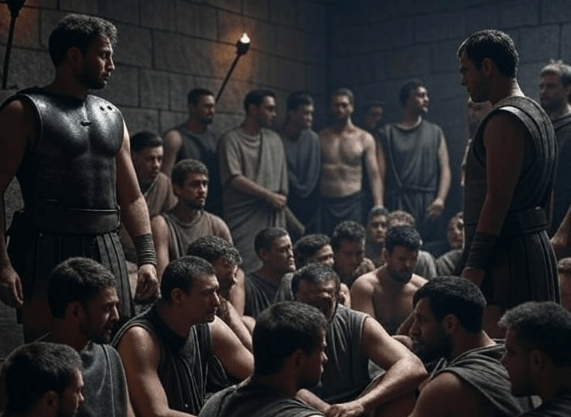

Let us tell the story of the greatest speech ever delivered by an American president.
Continue reading
Let us tell the story of the greatest speech ever delivered by an American president.
Continue reading
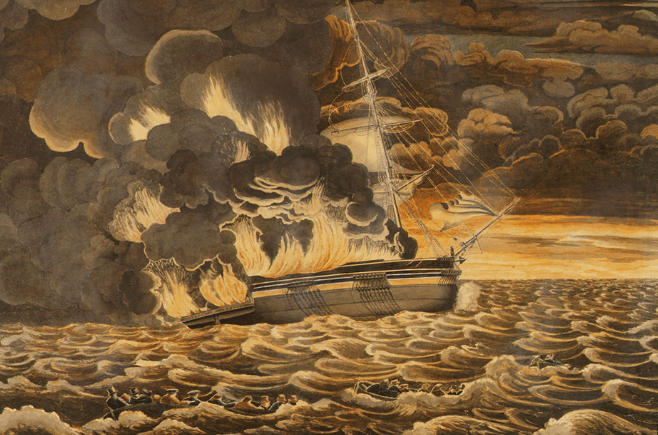
No one should doubt the extraordinarily destructive power of lightning. A dramatic illustration of this power occurred in 1830, when the packet ship Boston was hit by a bolt of lightning in the Atlantic and burned to the waterline, with the loss of one unfortunate passenger.
Continue reading
The French naval officer and explorer Antoine Bruni d’Entrecasteaux was born at Aix-en-Provence in 1739. He enlisted in the French Navy in 1754; but he must have shown promise to his superiors, for they granted him an officer’s commission two years later.
Continue reading
The following story is found within the pages of an 1840 volume entitled The Book of Shipwrecks and Narratives of Maritime Discoveries and the Most Popular Voyages. The narrator of the tale, as seems to have been the custom in those days when relating first-hand accounts, has omitted some specific details, such as the ship’s name, the dates, and the identities of major protagonists.
Continue reading
This incredible story is found in the pages of The Book of Shipwrecks, Narratives of Maritime Discoveries, and the Most Popular Voyages, which was published in Boston in 1840. I relate it as it is described therein. Specific dates and names have been omitted, not by myself, but by the original author, who was a witness to the events. This discretion seems to be consistent with the regular practice of the era.
Continue reading
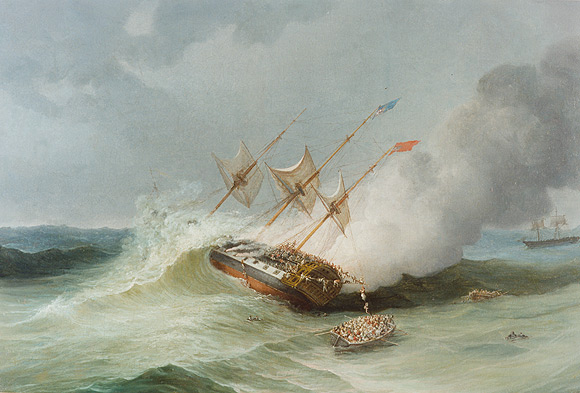
We will relate the terrible loss of the ship Kent, which sailed from the Downs on February 19, 1825. As a so-called East Indiaman (a merchant vessel trading with the East Indies), the Kent was bound for Bengal in India, and then China. She was a ship of 1,350 tons, and aboard her were 344 soldiers, 20 officers, 43 women, 66 children, 20 civilian passengers, and a crew of 148 men. The sum of these numbers comes to a total of 641.
Continue reading
In the 1998 film Fallen, one of the characters intones an ominous motto: “What goes around, really goes around.” This is a more emphatic version of the old adage, “What comes around, goes around.” In both cases the meaning is the same: he who spreads iniquity and evil, will eventually be himself visited by iniquities and evils of even greater magnitude.
Continue reading
We often underestimate the ease with which terrible disasters can accompany our efforts and enterprises. Vigilance tends to lapse with routine; and with time, even the most dangerous cargoes may begin to look benign. Any nation wishing to handle nuclear materials enters a kind of pact with the devil: in return for power and prestige, it can never forget what it is dealing with, and it can never let its guard down. Two lines from the Roman poet Lucan (Pharsalia IX.1020) expresses this idea well:
Continue reading
Philosophers and theologians have often pondered whether, or to what extent, wicked deeds are punished within the lifetime of a malefactor. Some maintain that the consequences of evil actions can never be avoided, and that, sooner or later, divine retribution will be visited upon him who offends the gods of justice. Others take a different position, and hold that punishment for the commission of foul acts is a purely random occurrence. Some men, they say, arrive at their appointment with Fate, while others seem to lead charmed lives, escaping justice while walking through life’s raindrops. As for which view is correct, no man can know. For my own part I tend to subscribe to the belief that wicked deeds always exact a certain price from their authors. That price may be postponed, or deferred, or placed in arrears, or hidden from the view of others; but the levy nevertheless weighs on the soul of the malefactor, and steadily corrodes it from within.
Continue reading
In 1822, Alexander Garden, an aide-de-camp of Major General Nathanael Greene, published a fascinating work titled Anecdotes of the Revolutionary War in America, With Sketches in Character. Some of the stories contained in the volume are based on Garden’s own experiences, or were conveyed to him personally by veterans of the conflict. Out of a great many fascinating and forgotten morsels, I have selected two for the reader’s enjoyment.
Continue reading
You must be logged in to post a comment.