Starting Out With The Roosevelt-Rondon Expedition In Brazil

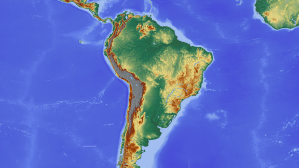
The naturalist Leo E. Miller published an engaging record of his South American adventures in 1918 entitled In the Wilds of South America.  We have previously related one of his adventures in Colombia, his quest for the elusive “cock of the rock” whose nesting places were perched over inaccessible, cavernous waterfalls.  While he was in British Guiana, he received word that ex-president Theodore Roosevelt had received permission from the Brazilian authorities to explore the ominously-named Rio da Duvida in the Amazon; he would be guided in this effort by Brazil’s most famous living explorer, the indestructible Candido Rondon.
Continue reading

Hunting For A Rare Bird In The Colombian Jungle

The naturalist Leo E. Miller was a participant in the famed Roosevelt-Rondon Expedition of 1913–1914 that explored Brazil’s unknown Rio da Duvida.  He also had a distinguished career exploring the wilds of many different South American countries and cataloging various species of animal life; he would later record these experiences with the publication in 1918 of In the Wilds of South America.  

Continue reading

The Strange Travels Of Pietro Della Valle

Pietro Della Valle was an accomplished traveler as well as a literary figure in his own right.  Other great names of Middle Eastern exploration came after him, but he was one of the very first pre-modern Westerners to gain first-hand experience in the region.  As the reader will discover, he was also undoubtedly the most eccentric.  He was born in Rome on April 11, 1586, to a distinguished family that was able to provide him with a good education.  Developing a flair for literature at an early age, he thirsted for the glories of the sword as well as the glories of the pen; and to this end, he signed up for adventure with a Spanish fleet in 1611 on an expedition to the North African coast.

Continue reading

The Remarkable Travels Of Jonas Hanway, And What He Learned From Them

Travelers and explorers march on; and I march on with my retellings of their adventures and philosophies.  I suspect that few readers will have heard of the great English traveler and philanthropist Jonas Hanway; yet his career and worldview embodies many of the values we have extolled here, as we will understand later in this article.  Hanway’s journeys in Russia and Persia alone make him worthy of inclusion among any list of great itinerants; but, when these experiences are combined with his expansive moral and ethical philosophy, we have the ingredients of true greatness.  The world needs more men like him now.

Continue reading

The Travels Of William Of Rubruck In Central Asia And Mongolia

Long are the roads walked by the lonely, intrepid traveler.  Not for him are the well-worn pathways of the conventional sightseer; for he is a seeker, and seekers by definition prefer the untrod vistas of the globe.  He will deliberately chose the unknown road, the trails less walked, the scenes less scrutinized, and the more risky propositions:  and he does this because he must, because some devilish inner compulsion drives him forward, like a demon nipping at his heels.

Continue reading

The Travels Of Constantin De Volney

Every traveler has a different tale, but the travel itself has the same purpose:  to push through boundaries, overcome obstacles, and to seek out what is not known.  This impulse in man will never change.  And it is right that this is so, for without it the progress of the human race might come to a shuddering halt.  In reviewing the lives and careers of great travelers, we feel almost as if they were animated by some unconscious impulse, some unfathomable compulsion, to thrust out the boundaries of their knowledge.  Every man must determine for himself his own outer limit.  The demarcation is intense, and personal; and it cannot be any other way.

Continue reading

Adam Olearius: Amazing Travels And Explorations In Russia And Persia

In the early seventeenth century, the steppes of Russia were almost entirely unknown to western Europeans.  Forests were thicker than they are now, roads were fewer and more difficult to navigate, and travel required much more money and resources than it does now.  One had to be sponsored by a wealthy patron, or be an official representative of a government.  It is to this latter category that the German explorer Adam Olearius (1599–1671)  belonged; he was one of the first westerners to penetrate deeply into Russia and Persia, and the account he left behind is one of the more fascinating works of travel literature that I have seen in recent years.

Continue reading

Charles Sturt: A Pioneer Of Australian Exploration

The student of the history of exploration and discovery cannot fail to notice certain recurring patterns in the lives of great explorers.  Many of them come from modest or poor backgrounds; many have military experience; many are driven by an inner conviction that they are destined for great achievements; many have a high tolerance for pain and hardship; and some of them have combative or disputatious natures that make them difficult to get along with.  Not all of these generalizations are found in every explorer, of course.  But it cannot be denied that a certain personality type is well-suited to a life of exploration.

Continue reading

Carsten Niebuhr: Sole Survivor Of The Danish-Arabian Expedition

Of the German explorers of the eighteenth century, the only man whose accomplishments rival those of Alexander von Humboldt is Carsten Niebuhr.  His extensive travels and surveys in the Near East and India resulted in specific geographical data, surveying information, and historical insights.  This was no dreamy wanderer; this was a trained professional, a man who was tough, hard-bitten, and practical, with the astuteness to process what was going on around him and commit his observations faithfully to paper.

Continue reading

Carl Friedrich Philip Von Martius’s Daring Explorations In Brazil

Men undertake explorations and great journeys for many reasons.  Some expeditions–such as those undertaken by Denham, Burton, Burckhardt, and others like them–are primarily focused on expanding geographical knowledge, commercial information, and ethnographic data.  Others, such as those of Humboldt, Rondon, Lewis and Clark, and von Barth, are more interested in the collection of scientific information about the natural world.  The Brazilian explorations of Carl Friedrich von Martius falls into the latter category.

Continue reading