John Lewis Burckhardt’s Travels And Explorations In Nubia

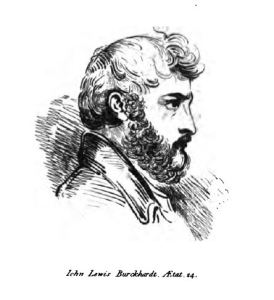
J.L. Burckhardt’s intensity and determination clearly show in this engraving.

In a previous article we have sketched the life of John Lewis Burckhardt.  He was born in Lausanne, Switzerland in 1784 of a prominent family.  At the age of 16 his father moved the family to Leipzig; and four years after this they moved again to  Göttingen.  His family was staunchly opposed to the new Napoleonic government that had taken power in France, so he moved to London in July 1806 to seek employment prospects there.  At some point, and possibly influenced by the daring men he had contact with there, he decided on a career in exploration.
Continue reading

The Boar And The Wolf Of Sant’ Antonio

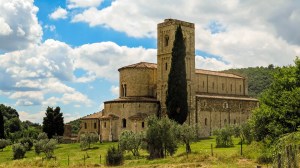
I will turn again to Biondo Flavio’s geographical compendium of Italy called Italia Illustrata, which was published in 1453.  Flavio traveled all over the Italian peninsula and recorded historical information, anecdota, and local customs of the Italian countryside in the late medieval period.  During his tour of Tuscany, he found himself in the region near the city of Petriolo.  Here there was a remote monastery dedicated to Sant’ Angelo named the Eremo di Sant’ Antonio in Val d’Aspra.  Flavio describes the place as being at the top of an irregular road threading through forested hills.  It was also an austere place, not lavish at all in its construction (ut ad parum sumptuose et minus laute aedificatum te conferas monasterium).

Continue reading

Impressions Of Belo Horizonte, Brazil

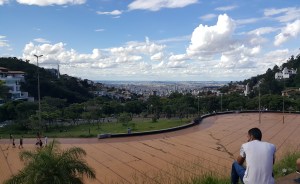
I spent the recent holidays in Belo Horizonte, which is the capital of the Brazilian state of Minas Gerais.  It was a fantastic trip, and I wanted to give readers my impressions of the city.

Continue reading

John Lewis Burckhardt’s Pioneering Explorations And Travels In Arabia

Before Sir Richard Burton, there was John Lewis Burckhardt.  Like many of the great names featured in these pages, he is little known today; but he sacrificed his life in the cause of discovery, and acquired a knowledge of the Arabic language and Islamic customs that has been surpassed by very few–if any–Westerners.  Had he lived longer, his achievements would likely have gotten the recognition that they deserved from posterity.

Continue reading

The Need To Escape (Podcast)

The theme of this podcast is the subject of escape, and how it is connected with travel and discovery. We explore this theme through the prism of two recent movies: “The Last Days” (2013) and “The Way Back” (2010).

Continue reading

The Incredible Life And Explorations Of John Ledyard

Of all the explorers and travelers I have written about, few are as fascinating and as little-known today as the American adventurer John Ledyard.  He lived from 1751 to 1789, during the seminal years of American history; and his travels across the globe (especially in Russia and Siberia) mark him out as a man who deserves far more recognition than he has received from posterity.  In fact, as I was researching his life in preparation for this article, I could hardly believe that his name had sunk into such undeserved oblivion.  Let us give him his due now.

Continue reading

The “Voyager” Program: Mankind’s Most Distant And Awesome Explorations

We have in these pages chronicled the feats of great explorers of previous eras.  Yet our own era has witnessed what is perhaps the greatest, most awe-inspiring feat of exploration in the history of the man on earth:  the Voyager program that made its way through the outer solar system.  This was to be an exploration much different in kind from the great expeditions of old.  There were no pack mules, native guides, or recalcitrant companions; but there were the same incredible risks of environment and circumstance that have accompanied exploration from the time the Phoenicians first circumnavigated Africa.  The Voyager probes were man’s first tentative steps to walk beyond the confines of his own planet.  Perhaps when the long perspective is finally taken by our remote descendants, the Voyager program will rank among the most the most significant event in the history of our species.

Continue reading

Dixon Denham: Pioneering British Explorer Of Central Africa

We have previously described in these pages the exploits of Heinrich Barth, one of the titans of African exploration.  Before him was Dixon Denham, a British explorer whose name is also hardly known today.  He covered some of the same ground as did Barth, but he had a different style; where Barth was a scientist and ethnographer at heart, Denham was a soldier with an eye for people, relationships, terrain, and–it must be said–trouble.

Continue reading

Heinrich Barth: An Incredible Explorer And Ethnographer

The name Heinrich Barth is almost unknown today.  But he is without doubt the greatest explorer that Germany produced in the nineteenth century, and probably even in the twentieth.  Not only did he penetrate completely unknown regions of Africa, but he kept a meticulous record of his travels, to such an extent that his published works are still useful to scholars today.  Even in his own day he did not receive the recognition that he deserved; central Africa was then so unknown even to educated Europeans that a balanced appraisal of his work was not possible at the time.  Yet a review of his life and travels leaves little doubt that he must be ranked among the bravest and most resourceful of all explorers of the African continent.

Continue reading

The Fragility Of Historical Knowledge: The Case Of Lorenzo Boturini In Mexico

In the modern era we like to think of knowledge as something indelibly fixed and permanent.  We take it for granted that it will always be here, like the Great Pyramid, and are apt to overlook the bitter struggles that our ancestors may have endured to acquire such knowledge.  Information has not always been as easy to obtain as it is now.  As we read about the adventures of scholars of the past, we get the distinct impression that the learned men who came before us had a hardiness and tenacity that is lacking in the modern era.  I will let the reader judge for himself.

Continue reading