
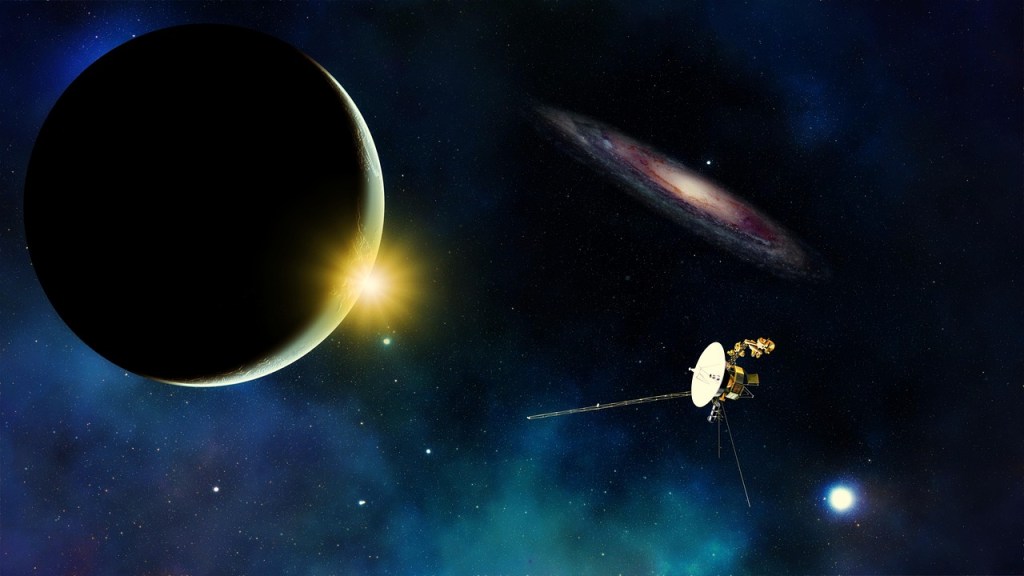
Some conceptions are possessed of such awesome magnitude and gravity that the mind can only with difficulty apprehend their sublime grandeur. I would like to share one such idea.
The Voyager 1 and Voyager 2 space probes were launched by NASA in 1977. Each weighed about 700 kilograms. Their stated mission was to photograph the outer planets and moons of our solar system. Yet, as we will see, they were tasked with another, more cosmic, responsibility: they were to be starry messengers announcing our existence and the existence of our planet. The two spacecraft are powered by radioisotope thermoelectric generators. What does this mean? It means that these complex machines rely for their operation on the decay of the isotope plutonium-238. As the isotope decays, it emits heat, and this heat is used to create an electrical source, which in turn operates the probes. It is an efficient, reliable system, made necessary in the empty coldness of deep space.
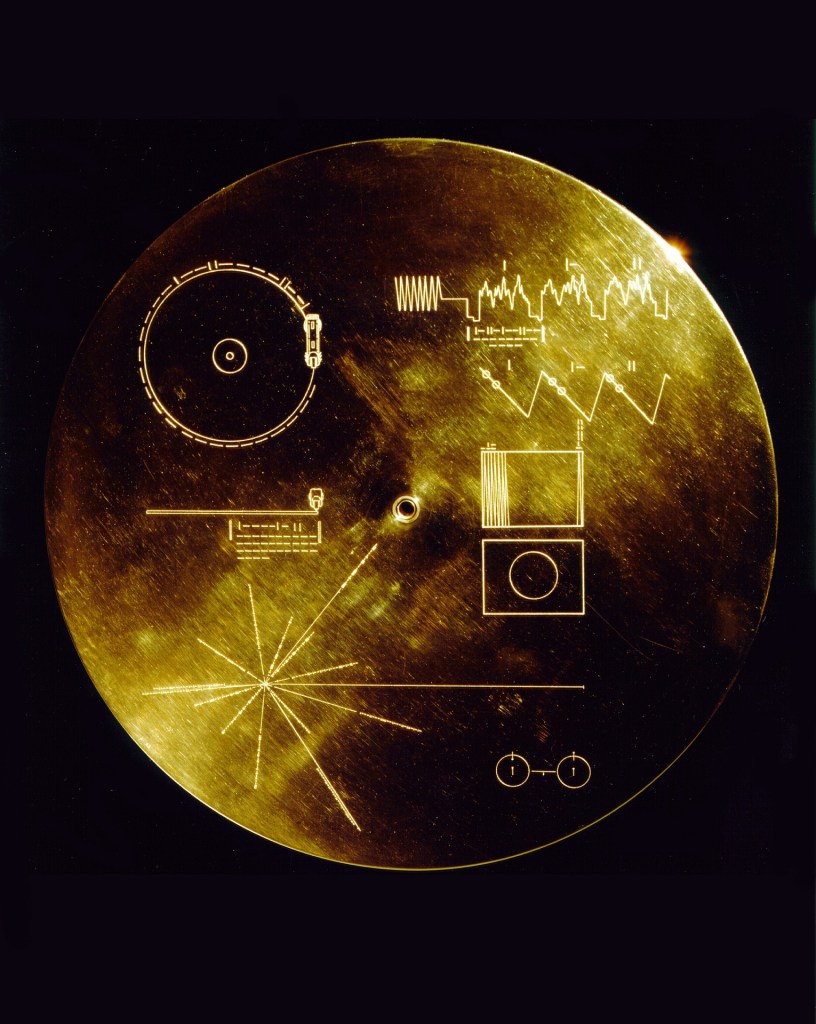
To each Voyager spacecraft was affixed something called the Golden Record. It is without doubt the most consequential testimonial object ever created by human hands. Its importance dwarfs that of the Code of Hammurabi, the Great Pyramid, and the Great Wall of China. It is a 12-inch copper disk plated with gold, and in its grooves were recorded a sample of sounds from Earth: rainfall, the sounds of animals, greetings in a variety of languages, even music. On its aluminum cover are etched instructions on how to play the record. Of course the chances of the record ever being found are essentially nil. But this does not matter, because I believe the real purpose of the record was not to communicate with an alien race, but to declare our own existence before all Creation. It is the human race’s literal shout into the void, a shout that will echo for all eternity. So basic to our species, so fundamental to its growth and sustenance, is this craving to be heard and acknowledged!
But as the isotopes decay and grow weaker, the operation of the probes becomes less certain. Eventually, in the early 2030s, the machines will cease to operate altogether. Voyager 1 crossed the heliopause (the region of space dominated by the sun’s solar wind and magnetic field) in 2012, followed by Voyager 2 in 2018. The probes will now pass through what is called the “Oort Cloud,” which is an immense cloud of rocks and debris that surrounds our solar system. Yet this is no ordinary cloud. It is so large that the probes, traveling at around 38,000 miles per hour, will still require about 30,000 years to traverse it fully. Imagine, if you will, these machines hurtling through this vast region, their original purpose long concluded, now having become eternal letter-carriers and ambassadors in the frightening limitlessness of cosmic time and space. There is almost no danger that the Voyager probes will collide with anything. Space is too vast and too empty for this to constitute any real possibility. Nor will they erode significantly. Their only enemy will be the fine, nearly imperceptible abrasion caused by interstellar dust.
After the probes escape the Oort Cloud, what happens then? Around ten thousand years after leaving the Cloud, Voyager 1, the faster of the two probes, will pass within 1.6 light years—a close encounter in cosmic distances—with a “red dwarf” star named Gliese 445 in the constellation Camelopardalis. By then, of course, Voyager 1 will be an inert artifact. But it will still be evidence of our existence, a whisperer in darkness, soaring through the emptiness of space, and persisting through the unfathomable longevity of time.
Voyager 2 will have its own separate trajectory. Ten thousand years after exiting the Oort Cloud, it will pass within 1.7 light years of a star named Ross 248, a red dwarf in the constellation Andromeda. At that time, Ross 248 will be the star closest to our own sun. After these stellar encounters, both probes will then continue to drift, for thousands upon thousands of years, in the void of interstellar space. Two hundred and ninety-six thousand years from now, Voyager 2 will pass within four light-years of the star Sirius, one of the brightest stars in our night sky. Consider this: this frail, metal machine, built in the 1970s, will be bathed in the searing light of Sirius, two hundred and ninety-six thousand years in the future. Will the human race even exist at that time? Will we have evolved into an entirely different species? Will the inhabitants of Earth even remember that Voyager 1 and 2 existed? Our planet’s geography and terrain will then be all but unrecognizable.
The probes will continue to drift, but they will not be able to leave our galaxy, the Milky Way. Their velocities come nowhere near the “escape velocity” required to burst out of our galaxy and plunge into intergalactic space. Instead, the probes will forever orbit the Milky Way’s galactic center, slowly circumambulating around the distant core. One revolution around this core requires, we are told, between 225 and 250 million years. This span of time is so immense as to be incomprehensible. The Voyager probes will become part of the Milky Way’s galactic matter itself, like any other comet or asteroid, completing laps that require hundreds of millions of years. The machines will move along the Milky Way’s spiral arms. They will be present at the birth and death of countless stars whose identities we will never know; they will drift through nebulae and asteroid belts; and they will become participating actors in a drama whose plot, scenery, and conclusion will never be disclosed.
Eventually—about five billion years from now—our sun will die and, in its death throes, it will consune Venus, Mercury, and Earth. The human race will expire. Our planet will pass into oblivion. Yet the Voyager probes will still exist. With no air or water to wear them down, the metal ships will last essentially forever. Tiny bits of cosmic dust, micrometeoroids, will gradually affect their metallic skins; but the machines will probably remain intact for billions of years, which is essentially an eternity. They will still be residents of the Milky Way, floating silently, until our galaxy merges with the Andromeda galaxy in about five billion years.
When the human race is no more, when our planet dies, the Voyager probes, with their precious testamentary cargo, will still exist. These silent sentinels, these whisperers in darkness, will be all that is left of us, the only remaining object fashioned by our race. They will be our final voice. Cicero coined an interesting word that only he used, a word whose only appearance in classical Latin is found in his writings. The word is intermundia, and it means the space between worlds; and this is exactly where the destinies of the Voyager probes are to be found. They are our infinite whisperers in the mute immensities of intermundia.
.
.


You must be logged in to post a comment.