
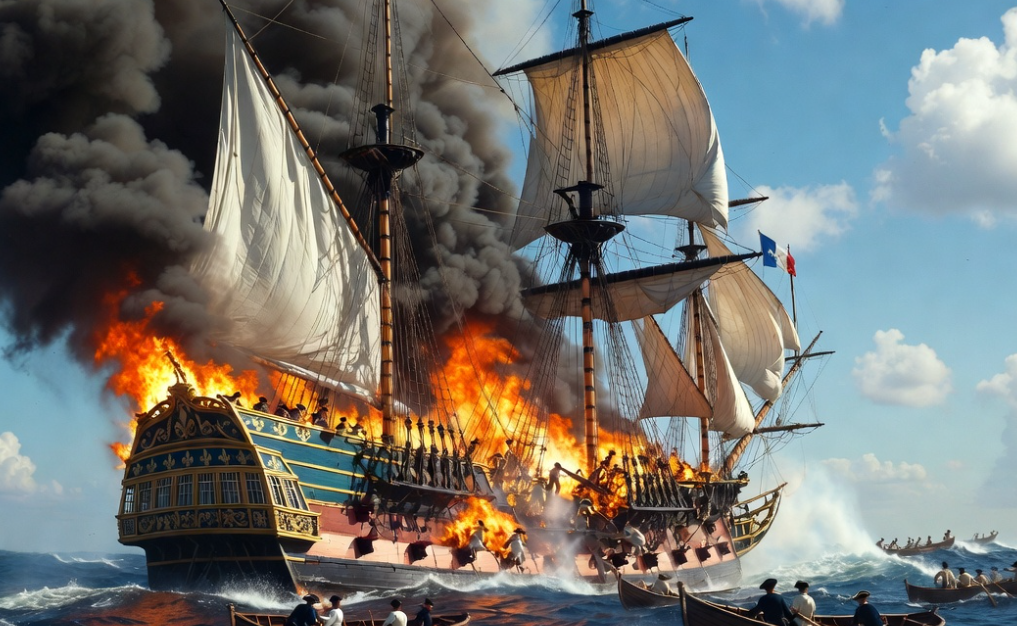
The French East Indiaman Prince left Port L’Orient in France on February 19, 1752. She soon ran into trouble, and became temporarily grounded on a sand bank; but her captain, M. Morin, ordered some cargo to be thrown overboard, and the lightened vessel was able to proceed. The ship returned to port temporarily for repairs, and set out again on June 10th of that year.
On July 26, the Prince met with disaster in the mid-Atlantic. One of the ship’s officers, Lieutenant de la Fond, was informed by a crewman that there was a fire below decks; the sight of billowing smoke seeping from the hatches attested to the truth of the information. De la Fond immediately ordered spare sails to be soaked in seawater and stuffed in the hatches, in an attempt to suffocate the blaze. Water was also pumped into the hold by the frantic crew. These measures, however, were to no avail, and soon orange flames could be seen flickering from beneath the hatches. Eventually the captain was forced to concede the inevitable, and ordered steps to be taken to abandon the ship. Yet in the confusion generated by the fire, one of the long-boats fell on the guns with its bottom upwards, and could not be freed from this condition.
Once it became clear that there were not enough boats, panic swept through the Prince. Trapped human beings, as many terrible tragedies have demonstrated, will do anything to escape roaring fires. Many simply leapt into the sea, clutching at whatever flotation devices they thought might save their lives. One father was seen holding his young son in his arms as he plunged into the waves. Captain Morin was especially tormented with guilt, as he had convinced some of his female relatives to accompany him on the voyage. With difficulty he convinced them to take to the sea, using chicken coops as life preservers. Eventually the Prince‘s guns, superheated by the flames, began to discharge; these explosions killed a number of crewmen.
Lieutenant de la Fond finally stripped off his clothing and plunged into the water, where he immediately had to fight his way through corpses, drowning men who sought to cling to him, and random bits of debris. He finally found refuge in a floating spritsail-yard, which already held about eighty survivors. The captain was nowhere to be found; but the chaplain was present, and from him de la Fond received a somber absolution. After some time, de la Fond saw the yawl (a type of ship’s boat) float by; its occupants allowed him to come aboard as long as he could swim to them. This he did. The survivors aboard the yawl watched in mute awe as the Prince was finally consumed by the flames; and when the fire reached her magazine, a huge explosion blew apart what remained of the vessel. Burning timber and red-hot cinders rained down on the exhausted survivors, adding to the apocalyptic horror of the scene.
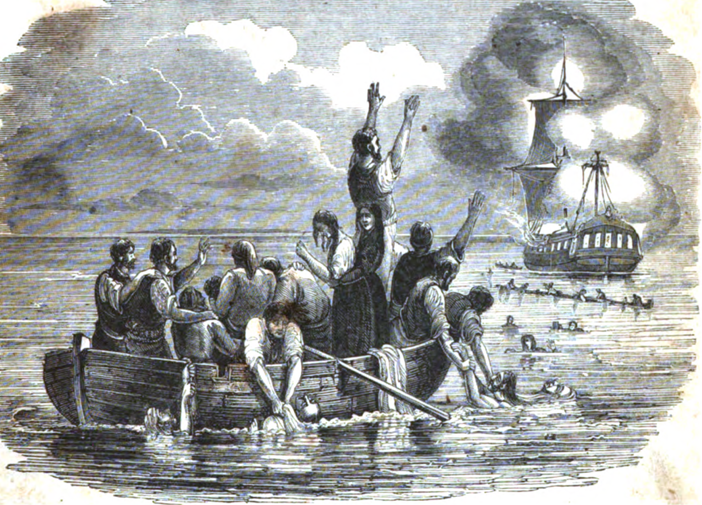
De la Fond suggested that they should row the yawl toward the ruins of the Prince, in the hope of salvaging food, water, and other necessities. Before the darkness of night descended, they had recovered a flask of brandy, fifteen pounds of salted pork, some cloth, and some rope. This was all. With difficulty de la Fond and a few seamen fashioned a crude sail from the salvaged cloth. They were about two hundred leagues from land, did not know in which direction to steer, and had no instruments with which to navigate. The experience and ingenuity of De la Fond and his crewmates were what saved the survivors. Observing the rising and setting of the sun, and the positions of certain constellations at night, the group was able to pilot the frail yawl towards land. They spent eight days and nights in the exposed craft, subjected to scorching heat and intense thirst during the day, followed by the terrifying blackness of the open ocean at night. A light rain shower on the sixth day offered some relief. De la Fond himself was close to physical collapse by the eight day, worn out by the burden of responsibility, hunger, exposure, and thirst; but he willed himself to endure nevertheless.
The miseries of the survivors finally came to an end when, on Wednesday, August 3rd, wisps of land were spotted on the horizon. The coast of South America drew nearer, and the emaciated survivors landed at Baía da Traição (Treason Bay) in the Brazilian state of Paraíba. After giving thanks to the Almighty for their deliverance, the survivors sought to locate any kind of drink or food. Soon they encountered about fifty shocked Portuguese residents, who did not know what to make of the sunburned, grizzled strangers, all of them either naked or clothed in tattered rags. After explaining their ordeal to their hosts, the Portuguese proved to be most gracious, conducting the Prince survivors promptly to water and shelter.
The survivors then visited a church dedicated to St. Michael, which was about a half-league distant, in order to give thanks for their rescue. After having rested and consumed food and drink, the Prince survivors decided to walk to Paraíba, which was about fifteen leagues away. The journey was made barefoot, and with very little in the way of provisions. With the brandy they had salvaged from the wreck, they bought an ox, slaughtered it, and preserved the meat for their journey. They made the journey, reached Paraíba, and met the governor, who proved kindly and hospitable. De la Fond’s feet were so lacerated that he could barely walk by this time. After three days the survivors sought to reach the city of Pernambuco, from which ships regularly sailed for Europe. They sailed from Pernambuco on October 5, and reached Lisbon on December 17th. De la Fond eventually found his way to Morlaix, and then to Port L’Orient. But he was among the fortunate, for he had survived. Nearly three hundred of the Prince’s crew and passengers had not.
.
.
Read more stories of endurance and survival in the essay collection Centuries.


You must be logged in to post a comment.