
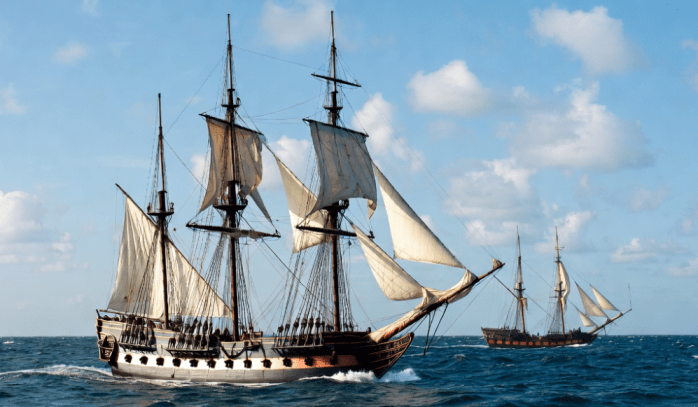
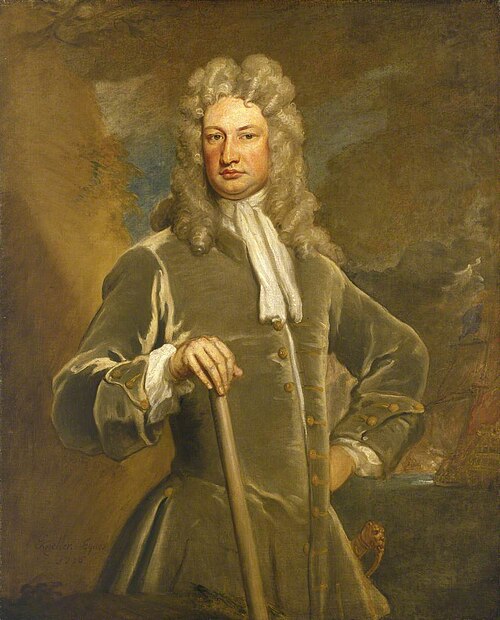
Sir Charles Wager served as Britain’s First Lord of the Admiralty from 1733 to 1742. He had a long and distinguished naval career, both at sea and ashore; and it will be useful for us to relate an anecdote from his early life that discloses much about his character and fortitude. The story that follows is found in the 1840 volume The Book of Shipwrecks and Narratives of Maritime Discoveries and the Most Popular Voyages.
Wager was born in Rochester, Kent, in 1666. He served as a cabin boy under one Captain John Hull, a devout Quaker, during a transatlantic voyage from the American colonies to England. It is not clear how old Wager was at the time, but it seems he was in his early teenage years. As Wager’s ship neared its destination, it was chased down by a French warship. Hull felt there was little he could do about his predicament; his ship was unarmed and could not hope to outrun its French opponent. Captain Hull was working up the nerve to surrender the vessel, when he was approached by his spirited cabin boy, Wager, who asked if there was anything that he himself could do. The captain frowned, informing the boy that everything that could be done had in fact been done, and that the current situation was hopeless.
This, however, was not a good enough answer for Charles Wager. Whereas others might have simply accepted what seemed to be inevitable, Wager was not yet prepared to yield. He walked to the center of the main deck and shouted for the crew to assemble. He told the men that Captain Hull believed that resistance was futile; but, he told the astonished sailors, if they were willing to put themselves under his command, he had a plan that might be able not only to salvage the situation, but to bring victory. The sailors, somewhat stunned by the boy’s resolution yet deeply impressed by his sincerity, agreed to give him a chance. He communicated his plan to them, and made sure everyone understood how it would be executed.
They did not have long to wait. The French warship pulled alongside Captain Hull’s merchant vessel, and threw out grappling hooks, locking the two ships together. The French sailors, exhilarated by their easy victory, clambered aboard with shouts and laughter. Yet they did not leave many men to stand watch on their own ship, a fact that Wager had hoped would happen. When Wager saw the French ship had been reduced to a skeleton crew, he gave a prearranged signal and, all at once, his men violently surged off their own ship and leaped on the decks of the French warship. The Frenchmen were slow to react, for they were taken completely by surprise. For weapons Wager and his comrades seized whatever they found lying about on deck: poles, cudgels, axes, lengths of rope, and whatever else was available. They fought fiercely with the French skeleton crew, overpowered them, and eventually took control of the ship; other men were assigned to cut the grappling lines that had lashed the ships together, so that the Frenchmen could not return to their ship of origin. The French crew was now stranded, enraged and dismayed, in the open ocean.
Wager himself now seized the helm of his new prize, and moved the French ship some distance away from the shocked men now marooned on Captain Hull’s vessel. Wager called out to his opponents, and commanded them to follow him. If not, he told them, he would blow them out of the water. The French sailors knew this was no idle threat, for their guns had been fully charged before boarding what they believed was their prize. Wager then steered his prize into port in England, followed by his utterly humiliated captives. The Admiralty was so impressed by the boy’s initiative and daring that they inducted him immediately into the Royal Navy, made him a midshipman, and gave him an education. Wager’s naval career was an illustrious one, but we need not discuss it here. He was eventually knighted for his services, and died in 1743.
It is no exaggeration to say that Wager’s early heroism defined his character, and determined the course of his life. Courage is never wasted, and bravery will always leave its mark. When all appears to be lost, and when tired, weak men in authority counsel surrender and humiliation, it often happens that young men of daring and vision must step forward and take matters into their own hands. No situation is entirely hopeless; there is only the presence, or absence, of one’s will.
.
.
Read more stories of decision and command in the new, annotated translation of Cornelius Nepos’s Lives of the Great Commanders.


You must be logged in to post a comment.