
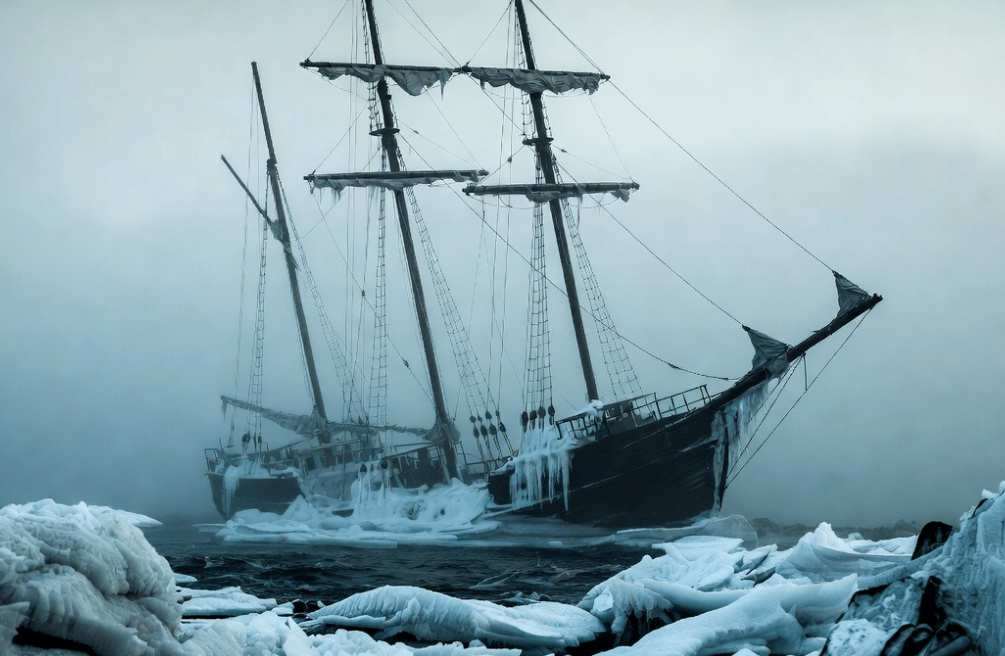
We have in these pages chronicled many shipwrecks and maritime disasters, each of which is woeful in its own way. The wreck of the barque Mexico in 1836, however, evokes particular pity, not only from the fact that its victims—most of whom were women and children—perished from freezing, but also because the wreck occurred so tantalizingly close to shore. Let the tale be told.
The Mexico set out from Liverpool on October 26, 1836 with a crew of twelve and a passenger list that numbered one hundred and four. The passengers were mostly Irish immigrants seeking a new life in the young and flourishing United States. She was commanded by Captain Charles Winslow. The transatlantic crossing was arduous: it took sixty-nine days, and was accompanied by severe food shortages and unrelentingly rough seas. On the night of December 31, 1836, the ship made the Highland Lights, the prominent twin lighthouses on the Navesink Highlands in New Jersey. Then weather conditions worsened dramatically. A ferocious gale blew in, driving the ship off course a distance of around fifty miles. Frostbite debilitated six of the crew, leaving only the captain and two seamen to maintain the vessel. The mate then used a lead line to take a reading of the water’s depth, and found the depth to be sufficient to ensure the ship’s safety. This reading was incorrect, as events would show; the error was probably due to the fact that the line was frozen stiff when the measurements was made.
By this time, however, the freezing cold had reduced both crew and passengers to a state of near incapacity. A contemporary account reports that the cold was so extreme that it was not possible to remain on deck for more than thirty minutes at a time. In the early morning of January 2, 1837, the Mexico struck a sandbar near shore, sending shudders and cracks through the ship’s frozen timbers. The ship was twenty-six miles east of Sandy Hook on Hempstead Beach on Long Island’s south shore. The ship remained paralyzed for about two hours, during which time she was battered continuously by waves. Soon her rudder was knocked off. Attempts to rescue the passengers were feeble and ineffective, as the sea was too violent, and the cold too extreme. Eventually the ship filled with water; the passengers were ordered to come on deck, where they suffered greatly from exposure.
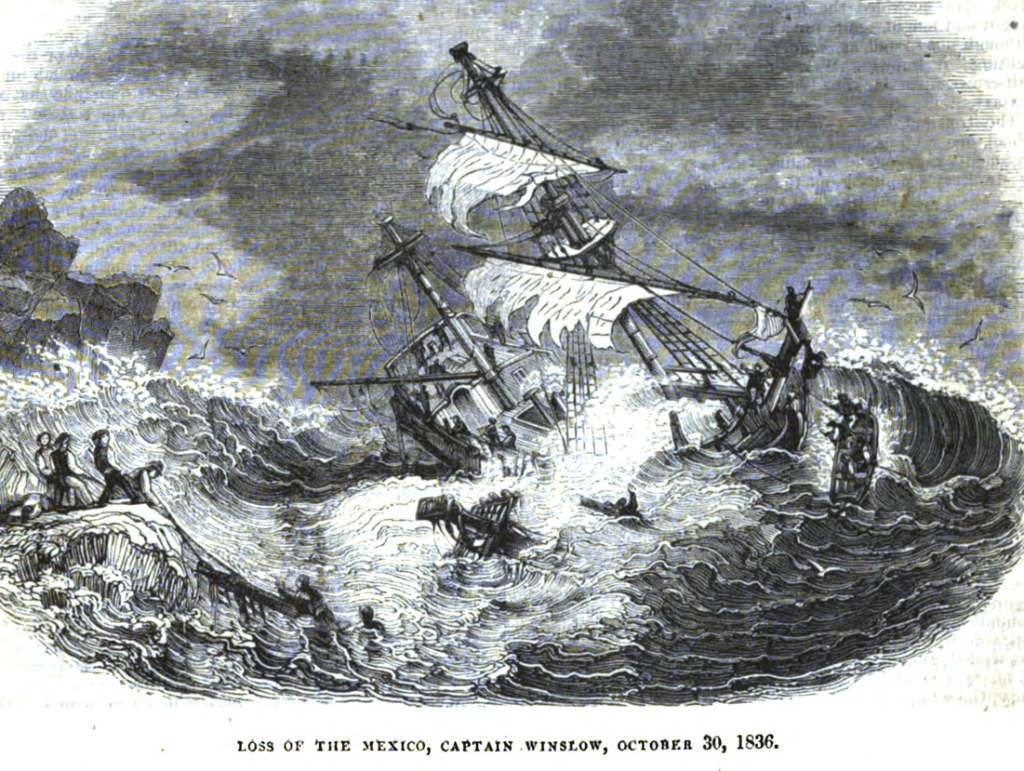
A rescue boat was launched from the beach, which succeeded in removing Captain Winslow and seven men. The captain thus saved himself, and abandoned his passengers to the merciless elements, a decision for which he was rightly berated later. A contemporary account relates that the passengers, wrapped in ice-coated blankets, began to shriek with terror and despair once they realized that no further efforts would be made to save them. Their pathetic cries persisted into the night, when, one by one, death brought them to silence.
When rescue teams reached the remains of the Mexico the next morning, they discovered scenes of horror unlike any witnessed in living memory. Even hardened mariners were shaken. The victims had lashed themselves to different parts of the ship in an effort to avoid dropping into the waves; their corpses were now encased in ice. There had been no drownings: all had died from freezing. The testimony of one visitor to the scene is so compelling that it deserves to be transcribed here at length:
On reaching Hampstead I concluded to go somewhat off the road to look at the place where the ship was cast away. In half an hour we came to Lott’s Tavern some four or five miles this side of the beach where the ship lay—and here in its barn had been deposited the bodies of the ill-fated passengers which had been thrown upon the shore. I went out to the barn. The doors were open; and such a scene as presented itself to my view I certainly never could have contemplated. It was a dreadful—a frightful scene of horror.
Forty or fifty bodies, all ages and sexes, were lying promiscuously before me, over the floor, all frozen, and as solid as marble—and all, except a few, in the very dress in which they perished. Some with their hands clenched, as if for warmth; and almost everyone with an arm crooked and bent, as it would be clinging to the rigging. There were scattered about among the number four or five beautiful little girls, from six to sixteen years of age, their cheeks and lips as red as roses, with their calm blue eyes open and looking you in the face as they would speak. I could hardly realize they were dead. I touched their cheeks, and they were frozen as hard as a solid rock, and not the least indention could be made by my pressure of the hand. I could perceive a resemblance to each other, and supposed them to be daughters of a passenger, named Pepper, who perished, together with his wife and family.
On the arms of some were to be seen the impression of the rope which they had clung to—the mark of the twist deeply sunk into the flesh. I saw one poor Negro sailor, a tall man, with his head thrown back, his lips parted, and his now sightless eyeballs turned upwards, and his arms crossed over his breast, as if imploring heaven for aid. This poor fellow evidently had been frozen while in the act of fervent prayer. One female had a rope tied to her leg,which had bound her to the rigging; and another little fellow had been crying, and thus frozen, with the muscles of the face just as we see children when crying. There was a brother and sister dashed upon the beach, locked in each other’s arms; but they had been separated in the barn. All the men had their lips firmly compressed together, and with the most agonizing expression on their countenance I ever beheld.
A little girl had raised herself on tiptoe, and thus was frozen just in that position. It was an awful sight, and such a picture of horror was before me that I became unconsciously fixed to the spot, and found myself trying to suppress my ordinary breathing, lest I should disturb the repose of those around me…
As I was about to leave, my attention became directed to a girl,who I afterwards learned had come that morning from the city to search for her sister. She had sent for her to come over from England, and had received intelligence that she was in this ship. She came into the barn, and the second body she saw was that of her sister. She gave way to such a burst of impassioned grief and anguish that I could not behold her with out sharing in her feelings. She threw herself upon the cold and icy face and neck of the lifeless body, and thus with her arms around her, remained wailing, moaning, and sobbing, till I came away; and when some distance off, I could hear her calling her name in the most frantic manner…
So little time, it appears, had [the victims] to prepare for their fate, that I perceived a bunch of keys and a half-eaten cake fall from the bosom of a girl whom the coroner was removing. The cake appeared as if part of it had just been bitten, and hastily thrust into her bosom, and round her neck was a ribbon, with a pair of scissors suspended.
To observe the stout, rugged sailors, too,whose iron frames could endure so much hardship, here they lay—masses of ice. Such scenes show us, indeed, how powerless and feeble are all human efforts, when contending against the storms and tempests which sweep with resistless violence over the face of the deep. And yet the vessel was so near the shore, that the shrieks and moans of the poor creatures were heard through that bitter, dreadful night; till, towards morning, the last groan died away, and all was hushed in death, and the murmur of the raging billows was all the sound that then met the ear. After the storm, the wreck was approached, and here and there were seen columns, pillars of ice, which were formed on the frozen bodies, as the sea broke over them.
So occurred the terrible wreck of the Mexico. One hundred and fifteen lives were lost, most of them women and children. And what happened to Captain Winslow, who removed himself from the wreck and left the passengers to their fates? Although he faced heavy public criticism, it does not appear that he was ever reprimanded for his actions. In fact he seems to have continued his maritime career. A captain of the same name died in 1839 near the Strait of Gibraltar at the age of fifty, and his individual seems to have been the former captain of the ill-fated Mexico.


You must be logged in to post a comment.