
You can find a complete listing of all the articles on this site here. They are listed in reverse chronological order, and are all clickable links. Twenty-five articles are displayed per page, with the publication date included. To find older articles, click on the page numbers at the bottom.
To search the site by subject, topic, or name, you can use the “Search” function on the right sidebar.
_______________________________
-
Monstrous And Inconceivable: Jack London Builds His Ship To Sail Around The World
“Monstrous and inconceivable” was how Jack London described the conception and construction of his yacht Snark, the vessel on which he planned to sail around the world. The construction was beset by delays, cost overruns, and incompetence. London fought through the obstacles, even teaching himself celestial navigation while en route to Hawaii. This podcast describes…
-
Burst Away From The Shore, And Head For the Open Ocean
The Latin poet Claudian lived from about 370 to 404 A.D. He was born in Egypt but as an adult associated himself with the imperial court at Rome. One of his more famous works is the unfinished epic “The Rape of Proserpina” (De Raptu Proserpinae). The poem contains a short prologue which I have translated…
-
The Dolphin Of Hippo
Pliny the Younger described in one of his letters a story noted both for its sadness and its revelatory quality on a characteristic of human nature. The letter was written to the poet Caninius Rufus (IX.33), and in it Pliny recounts extraordinary interactions between a boy and a dolphin. I am not quite sure whether…
-
“I Just Left My Job, And Don’t Know What To Do Next” (Podcast)
A reader has just been laid off from his accounting job and is distressed. He is not sure what to do next, and is faced with a few difficult options. We discuss some general thoughts, and what principles to keep in mind.
-
Grave Offenses, And Little Thanks
In a letter to Titinius Capito, the Roman official and career lawyer Pliny discusses the idea of writing a book of history. Of particular concern to him was the choice of topic: he was uncertain whether he should treat an ancient or a modern subject. Valid arguments existed for both options. An older subject might…
-
Appeal To Athena, But Also Move Your Arms (Podcast)
We discuss two fables from Aesop that illustrate the point that we ourselves must take action, and not expect deities to come to our aid. When all is said and done, we must see ourselves as the architects of our own destinies.
-
Louis De Freycinet’s Epic Circumnavigation Of The Globe
Those who perform great deeds are guided by inner lights whose intensity never wanes. Perhaps the most significant French maritime expedition of the nineteenth century was that of naval commander Louis Claude de Saulces de Freycinet (1779—1841). Its chief aim, according to novelist Jules Verne, was “to survey the shape of the land in the southern…
-
The Greatest Hope Lies In The Justice Of One’s Cause (Podcast)
“In war the greatest hope lies in the justice of one’s cause.” This is a line from the historian Appian (IV.12.97), who lived from about 95 A.D. to 165 A.D. We discuss what this line means, and how we can apply it to our own lives.
-
The Patriarch: The Remarkable Life And Turbulent Times Of Joseph P. Kennedy (Book Review)
David Nasaw’s The Patriarch is a comprehensive account of the life and times of the founder of the Kennedy family dynasty, Joseph P. Kennedy. In many ways he remains the least understood Kennedy; his name has been subject to rumor, surrounded by myth, and maligned in whispers. Even during his life he remained a divisive,…
-
Hercules On Oeta: Immortality Through Virtue
As I have gotten older I find that reading plays brings more enjoyment than it did in earlier years. Tragedies especially: the unformed mind has not yet been sufficiently battered by the winds and waves of fortune against the rocks, and is equipped with a merciful immunity to the pathos of existence. And yet, as…
-
Al-Minara: The Pharos Lighthouse Of Alexandria
One of the more fascinating of the seven wonders of the ancient world was the Pharos Lighthouse in Alexandria, Egypt. I have lately been reading the history of the Arab conquest of Egypt in the seventh century, and have become more acquainted with some of the monument’s unique characteristics, and the legends that have surrounded…
-
You Don’t Need Anyone’s Permission To Succeed (Podcast)
In this podcast we discuss the subject of having the faith and confidence to follow your creative muse, without looking for the approval or endorsement of others. The herd is always going to try to enforce conformity. Do your homework, do your research, and learn your subject: but at the critical jumping-off moment, you need…
-
Coming In Late 2019: “Digest”
In late 2019, several months after the release of Lives of the Great Commanders, Fortress of the Mind Publications will release Digest, the definitive collection of the most important essays of Quintus Curtius covering the period 2016 to 2019.
-
The Life, Travels, And Literary Works Of Yakut Al-Hamawi
In some recent researches I have discovered one of the more interesting travelers and scholars of the medieval Islamic world. I have been encouraged to review what sources are available; and the more we learn, the more impressive his story becomes. His name is Yakut Al-Hamawi, and his career and achievements tell us much about…
-
A Very Good Chicken Dish
Before one can philosophize, one must eat. And so we turn now to the subject of eating. I wanted to share this recipe because I think it is inexpensive, flavorful, and simple to prepare. It requires no further justification.
-
How Pompey Cleared The Mediterranean Of Pirates
The Mediterranean became infested with pirates as a direct consequence of Rome’s Mithridatic Wars. Around 88 B.C. Mithridates VI of Pontus went to war against the Romans and moved into the province of Asia Minor. He took what plunder he could, and apparently decided that an effective way to wage irregular warfare against the Romans…
-
The Measurements Of Eratosthenes
Eratosthenes of Cyrene (c. 276 B.C.–c. 195 B.C.) is justly famous for his ingenious method of calculating the circumference of the earth. What is less widely known is the fact that he made other contributions to the history of mathematics, some of which we will discuss here.
-
A Relationship Question, And More G Manifesto Tweet Readings (Podcast)
This podcast is in two parts. The first part deals with a good question I received today from a girl who emailed me about a relationship question. She wants to know the best way to break up with a guy. The second part is a reading of some G Manifesto tweets, just to have a…
-
The Cultivation Of A Sense Of Humor
To be lacking in a sense of humor is a true misfortune. I would not go so far as to call it an offense against others; but it certainly is a detriment to oneself. Social media seems to magnify our sense of self-importance; and when self-importance escalates, so does our sense of grim momentousness. There…
-
Al-Farra And The Three Obligations Of Respect
Abu Zakariyya Yahya Ibn Ziyad is one of the more famous of the early Arabic grammarians. Known to history by his moniker Al-Farra, he was born in the city of Kufa around A.D. 761 and received an intensive education there in rhetoric, law, and theology. His biographer Ibn Khallikan calls him “the most eminent of…
-
A Reading From Jean de Joinville’s “Life Of Saint Louis” (Podcast)
Today was a difficult one to bear. We grieve, and feel dismay. I wanted to honor the spirit that created Notre Dame by reading some selections from Joinville’s Life of Saint Louis. He was the king of France known to history as Louis IX, and he lived from 1214 to 1270. The pious and selfless…
-
The Alexandrian Library: Dissipation Through Neglect And Apathy
Nearly every scholar of classical antiquity seems to have an opinion about the destruction of the Great Library of the Ptolemies at Alexandria in Egypt. It has become something of a symbol of the triumph of ignorance and superstition over knowledge. There is much merit to this view; but the picture is a complex one,…
-
Rehabilitation Or Retribution?
Investigative journalist Raphael Rowe’s new Netflix documentary series “Inside the World’s Toughest Prisons” provides a harrowing look at incarceration in different countries. Mr. Rowe has gone into the belly of the beast to learn the truth behind the prison systems of the world. It also prompts a larger, deeper question. What philosophy is better: rehabilitation,…
-
What Did A Roman Triumph Actually Look Like?
Like the ceremony of deification, the Roman triumph (triumphus) is one of those rituals about which few readers may have a clear picture. This is unfortunate, for the ceremonial triumph provides a very revealing window on certain aspects of Roman society. Ancient writers mention it frequently, but almost always in passing; we are seldom offered…
-
Generosity Should Be Bestowed With Care
There is a scene in the movie The Wild Bunch (1969) where Ernest Borgnine and William Holden are discussing the making of promises. Holden says, “We gave our word.” Borgnine angrily responds, “That ain’t what counts. It’s who you give it to!”
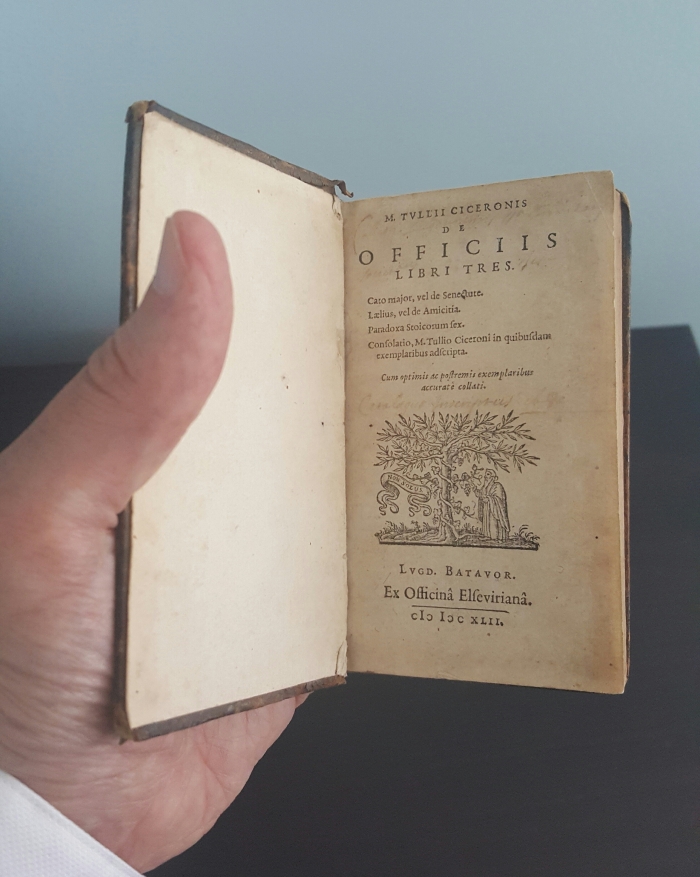
Original copy of Cicero’s De Officiis (On Duties) published in Holland in 1642. From the collection of Fortress of the Mind.


You must be logged in to post a comment.