

You can find a complete listing of all the articles on this site here. They are listed in reverse chronological order, and are all clickable links. Twenty-five articles are displayed per page, with the publication date included. To find older articles, click on the page numbers at the bottom.
To search the site by subject, topic, or name, you can use the “Search” function on the right sidebar.
_______________________________
-
Erasmus Loses All His Money, And Still Triumphs
We have observed many times before in these pages that disaster can often serve as an impetus to growth and eventual victory. This point was reinforced in an interesting story that I recently came across in a biography of the famous humanist Erasmus of Rotterdam.
-
The Sword Of Mars
The humanist Poggio Bracciolini wrote a long letter to his friend Niccolo Niccoli in November of 1430. The letter contained the following words:
-
People Want To Be Left Alone (Podcast)
In this podcast we talk about how the media deliberately tries to foment discord for its own self-serving purposes, and how this aligns with the purposes of the plutocracy. We compare this ethic to an interesting anecdote related by the Roman historian Priscus that occurred while he was traveling to the court of Attila the…
-
Coming Full Circle
As a man hopefully grows in experience and knowledge, he will begin to notice a curious thing. The knowledge that he continues to acquire, and the sights that he continues to see here and there, subtly redirect him back to where he first departed. It is almost as if some grand cosmic joke is at…
-
Whether A Man Can Change, And How He May Change
Can a man change, or are his personality traits so fixed that external circumstances are incapable of adjusting them in any significant way? This is a question that finds enthusiastic advocates for both answers. The cynics–or as they prefer to be called, the “realists”–tell us that personality does not change. Our knowledge contracts and expands,…
-
The Eloquence of Ali Ibn Al-Athir
Ali Ibn Al-Athir (علي عز الدین بن الاثیر الجزري) was an Arabic historian, poet, and scholar who served for a time under Saladin. Born in 1160 in the city of Jazeera Ibn Omar (the modern Turkish town of Cizre), he received his education there and in Mosul, Iraq. From an early age, he showed an…
-
A Humanist Visits The German Baths
The Renaissance humanist Poggio Bracciolini wrote a fascinating letter to his close friend Niccolo Niccoli in May of 1416 while on one of his book-hunting expeditions to remote monasteries Germany. While in Germany he had an opportunity to visit the baths near Kaiserstuhl, and he has left us a detailed description of the experience.
-
A G Manifesto Tweet Reading
Who the hell needs poetry readings when we can read the G Manifesto on Twitter (@MichaelPorfirio)?
-
Augustine’s “Misericorditer”: Benevolent Severity In Correcting One’s Enemies
I have recently learned of an interesting doctrine articulated by St. Augustine in one of his letters. The letter in question is Epistula 138, and I should describe briefly its context. One of Augustine’s friends was a pagan senator in Rome named Volusian; his mother happened to be a Christian, but he was not. The…
-
Age Of Spectacle: Chariot Races, The Hippodrome, And The Four Factions
To understand fully the social environment in which the eastern Roman empire operated, we must have some grasp of the unique culture surrounding Constantinople’s Hippodrome in the centuries that followed the disappearance of the Roman empire in the west. In Byzantium, sport and politics achieved a strange admixture that has no exact historical parallel anywhere…
-
The Fragility And Perishability Of Knowledge (Podcast)
In this podcast we discuss how fragile and perishable knowledge can be. We comment on the loss of Latin literature in the West, and the dissipation of the holdings of the Alexandrian library of the Ptolemies. It is clear that even a short period of neglect can result in the loss of a catastrophic quantity…
-
Preserving Something For Time To Make Better
Before I explore the main subject of this essay, I wanted to relate a tale about Alexander the Great’s leadership acumen. The historian Arrian relates an event that he believes best distills Alexander’s genius for command. It can be found in VI.26 of his History of Alexander. When Alexander and his army were passing through the…
-
Friedrich Schlegel, The Sanskrit Language, And The Beginnings Of Comparative Philology
The great antiquity and depth of Indian civilization had been known to Europe and the Middle East for many centuries; yet the precise contours of Indian advances in mathematics, literature, and philosophy were hidden behind the veils of preconception and confusion. We know that the caliph Harun Al-Rashid, in Baghdad in the 9th century A.D.,…
-
Antonio De Ulloa’s Explorations In South America
Antonio de Ulloa y de la Torre-Giral may have been Spain’s greatest explorer of the eighteenth century. The hardships he endured certainly merit his inclusion on any list of that century’s great cultivators of geographic knowledge. He was born in Seville on January 12, 1716; and like many accomplished travelers, he received a thorough education…
-
Treachery Ensnares Some, But Is Defeated By Others
Every man who goes about his business must be attuned to the realities of his surroundings. He should not close his eyes to what lies within his field of vision; and he must not delude himself by rationalizing the treacherous intentions of others. The prudent man will not see plots and conspiracies everywhere, for this…
-
A Reading From “Pantheon”: Ice Odyssey: Douglas Mawson’s Race Against Death
In this podcast, I read a chapter from my 2015 book Pantheon. The chapter is entitled “Ice Odyssey: Douglas Mawson’s Race Against Death.” It is good for us to be reminded of stories like this.
-
Georg Wilhelm Freytag’s Latin Compendium Of Arabic Proverbs
About a year ago one of the readers here at Fortress of the Mind informed me of a work of scholarship that he thought might be of interest. The work was Georg Wilhelm Freytag’s monumental Latin treatise Arabum Proverbia (literally Proverbs of the Arabs, but better rendered as Arabic Proverbs), a three-volume collection of classical Arabic…
-
Film Roundup (1/2/2019)
Here are some of the latest viewings.
-
The Villa Of The Papyri: A Glimpse At A Roman Book Collection
Sometimes an accident of history can preserve records of great value. As is well-known, Mount Vesuvius in Italy erupted in 79 A.D. entombing the towns of Pompeii and Herculaneum in ash and ejecta. In the eighteenth century, these sites began to be explored in a random and haphazard manner; one of the villas so discovered…
-
The Top Ten Articles At Fortress Of The Mind For 2018
The following articles were the most popular at the site in 2018. There are some surprises here. For the first time since the site was founded in 2015, a podcast made it to the top ten list. And not just one podcast, but two of them. They were “The Surrealistic World of Michael Porfirio” (at…
-
Ibn Qalaqis On The Importance Of Travel
The poet Nasrallah Ibn Abdallah Al-Qalaqis (نصر اللّه بن عبد اللّه القاضي الأعزّ ابن قلاقس) was born near Alexandria, Egypt in 1137. He was a master of language and a composer of many exquisite verses, and was also an intrepid traveler. The name by which he is generally known (Ibn Qalaqis) is derived from the…
-
Between Mouth And Morsel
The Roman writer Aulus Gellius relates an anecdote about his discovery of the meaning of an old proverb. He tells us that he read the following line in one of the speeches of Marcus Cato Censorius:
-
The Pride Of Mihyar Al Daylami
The poet Mihyar Al Daylami (?–1037) came from that region of Persia which bordered the southern shores of the Caspian Sea. He wrote in Arabic, and his works were so copious that his biographer says they filled four volumes. He was originally a Zoroastrian, but converted to Islam around the year 1003 under the influence…
-
A Man Is Often The Cause Of His Own Misfortune
A reasonable amount of experience in life teaches us that we are often the source of the wrongs that fall upon our shoulders. This is not always true, of course; but even a short period of honest reflection will reveal to us, if we examine the details of things, that we might have handled some…
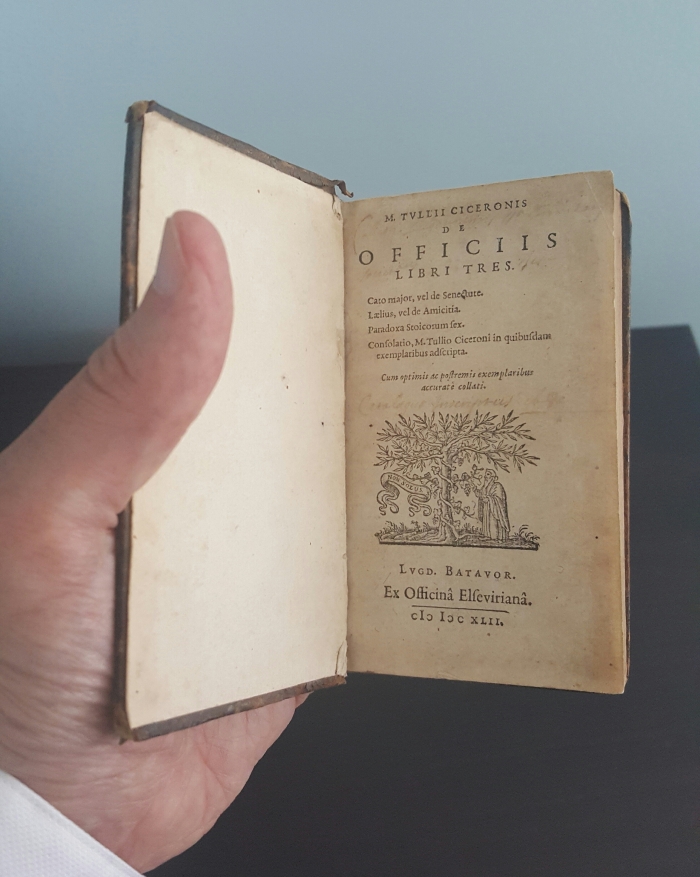
Original copy of Cicero’s De Officiis (On Duties) published in Holland in 1642. From the collection of Fortress of the Mind.
 Quintus Curtius
You must be logged in to post a comment.