
You Do What You Have To Do To Survive (Podcast)

A recent news article talks about how young, unemployed urban Greeks are leaving the city to return to agricultural work in the countryside.  They’re producing and marketing their own products directly to consumers.  It’s part of a wider economic trend that has a lot of positive features.

In life, you do what you have to do to survive.

Continue reading

Limits Must Be Imposed On Our Desires

Among the many problems that we are faced with today is the lack of restraint, the lack of moderation, that is actively supported and encouraged by our culture.  If you have something, you are told that you deserve more.  If you want something, you are told that you deserve to have it.  If something stands in the way of your getting something you think you deserve, you are told how to obtain that thing you desire.  Few people pause to think that what they crave may carry a heavy burden in the long run.

Continue reading

Why We Study Great Exemplars Of History

You may ask yourself why we study the lives and experiences of great exemplars.  When I say “exemplar” I mean a person of substance and distinction, a person of notoriety in some field of endeavor.  There are many reasons for this; I will attempt to give a few of them here.

Continue reading

How Al Fadl Al-Barmaki Learned Bluntness And Generosity

Al Fadl Ibn Yahya al-Barmaki (A.D. 766—808) was a government official who served the most famous of all the Abbasid caliphs, the great but mercurial Harun al-Rashid.  Besides serving in several administrative posts (such as governor of Khurasan), he was also trusted enough to tutor Harun’s young son and heir al-Amin.  Although he later fell out of favor with the caliph, many stories are told of his generosity and kindness.

Continue reading

The Dangers Arising From One’s Subordinates: The Case Of Eumenes

No matter how much ability a commander may have, his purposes will ultimately come to nothing if he is surrounded by discontented or disloyal associates.  It was for this reason that, as the historian Sallust relates, the Roman general Metellus decided to send his disloyal subordinate Marius back to Rome.  A further example of this is provided by the career of the Greek general Eumenes of Cardia (362–316 B.C.).

Continue reading

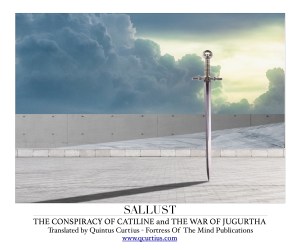
“Sallust: The Conspiracy Of Catiline And The War Of Jugurtha” Is Now Available

Click above for purchase information

I am pleased to announce that my latest book, an original and extensively annotated translation of Sallust’s Conspiracy of Catiline and War of Jugurtha, is now available for purchase.  It uses a fresh, modern English idiom that preserves the flavor of the historian’s famous epigrammatic style.  Fully outfitted for comprehension and efficient referencing, this special edition contains the following unique features:

Continue reading

Linnaeus And The Art Of Classification

One of the great names of eighteenth century science is the botanist Carl von Linné, more commonly known as Carl Linnaeus.  His primary importance to history lies in his innovative classification system for living organisms.  Before him, there was a chaos of competing names and terms for the swelling corpus of knowledge about plants and animals; after him, there was something approaching order.

Continue reading

Sunday Movie Roundup (5/14/2017)

This was a great week.  I’ve said it before, and I’ll say it again:  discovering unexpectedly good films in out-of-the-way places is one of the things that keeps my faith in cinema alive.  There are good things happening out there; you just have to be persistent and know how to wade through all the sewage.

Continue reading

“How Do I Convince A Student That His Ideas Are Wrong?” (Podcast)

A reader who is a teacher is troubled by the fact that one of his teenage students firmly believes in fascist government. The teacher seeks advice on how to deal with this situation. He relates this situation to similar experiences he had as a soldier in Afghanistan when he was speaking with local villagers.

Continue reading