
There is a scene in the movie The Wild Bunch (1969) where Ernest Borgnine and William Holden are discussing the making of promises. Holden says, “We gave our word.” Borgnine angrily responds, “That ain’t what counts. It’s who you give it to!”
There is a scene in the movie The Wild Bunch (1969) where Ernest Borgnine and William Holden are discussing the making of promises. Holden says, “We gave our word.” Borgnine angrily responds, “That ain’t what counts. It’s who you give it to!”

In this podcast we discuss some life advice offered by the medieval Arabic political theorist and philosopher Ibn Zafar in his treatise, Consolation of the Ruler Amid the Hostility of His Subjects. I’ve written several articles before about him that can be found on this site (use the search box in the upper right corner), and wanted to do a podcast about some of his life advice.

He remains one of the most impressive of the forgotten European explorers of the Middle East. He was born in Westmoreland in 1692, and entered Queen’s College at Oxford in 1711. Graduating in 1716, he accepted a position with a British commercial post in Algiers; this gave him the opportunity for a meandering journey through Europe before commencing the assignment.

There are times in life for calm reflection, and there are also times for ruthless and decisive action. When a man is faced with external danger and is being pressed by a crisis, he must act with speed and decision. The following anecdote, described in Appian’s Spanish Wars (VI.7), demonstrates why Scipio Africanus is eminently deserving of the accolades that historians have accorded him. For he was not only a commander of prudence and wise judgment; he knew how to draw the sword when the situation called for it.

According to his biographer Ibn Khallikan, a Christian physician of Baghdad named Ibn al-Talmid who practiced there around the year 1100 spoke the following words of advice:

Our trusted friend Ibn Muqaffa provides us with the following advice which I have committed to memory:

In this podcast we answer some of the most common questions I’ve received about the G Manifesto.
“Who is he?”
“What does he do?”
“Is he really doing the things he says he’s doing?”
We discuss some of the take-away lessons, and then go into some recent tweet readings.
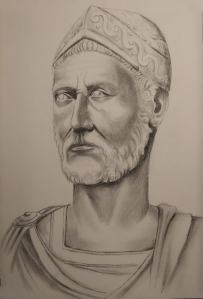
Fortress of the Mind Publications is pleased to announce that 2019 will see the release of the first illustrated, annotated translation of Cornelius Nepos’s Lives of the Great Commanders to appear in modern English.

If you’re feeling down and have two hours to spare watching an old sporting event, here is something guaranteed to lift your spirits. It is the hockey game played between the United States and the Soviet Union at the 1980 Olympic Games in Lake Placid, New York. I wanted to post this game for several reasons.

Although I do not live near the ocean now, I grew up in a small town that was close to it. The spirit of place enters imperceptibly into one’s bloodstream; and one gets used to the tang of rotting seaweed, the early morning salt mist, the relentlessly shifting dunes, and the omnipresent screams of the gulls. I have found that being near the ocean is restorative of health.


You must be logged in to post a comment.