

If you find yourself with free time on your hands during the next few days, you might want to check out a few of these titles. As always, I try to focus on the films that get little mainstream attention. You can decide whether you want to see them.
If you find yourself with free time on your hands during the next few days, you might want to check out a few of these titles. As always, I try to focus on the films that get little mainstream attention. You can decide whether you want to see them.

One of the great things about history, literature, and philosophy is that these subjects have the ability to take us down dark rabbit-holes every now and then. I think H.P. Lovecraft once said something like “seekers after knowledge haunt strange and dark places.” I can’t remember the exact quote, but it was along these lines. I was reminded of just how dark these can be last night as I was going through Procopius’s History of the Wars (a regular companion of mine for some months now). Anthony Kaldellis’s wonderful edition of this neglected work proves once again that the right translation of a work can make all the difference in whether a book blossoms into life or falls flat.

Captain Adolf Von Schell was a veteran German officer of the First World War. In 1914 he first served in Belgium, then saw extensive action on the eastern front in both Romania and the Russian border. After the end of the conflict in 1918, he stayed in the army; he was even sent to one of the US Army’s military schools in Fort Benning in 1930. He delivered many lectures to American officers on his combat lessons of the Great War; these were later collected and published under the title Battle Leadership.

From the years 540 to 562, the Eastern Roman Empire under Justinian was engaged in a drawn out struggle against the Sassanid Persians under Chosroes (Khosrow). This contest is usually called the “Persian War.” Many illuminating incidents that happened during this conflict I have used in previous articles here. Another one highlights the need for redundancy and “back-up” systems as security in times of trouble. We are aware of this principle when it comes to computing and software, but it can be applied to many other fields of activity. The following story demonstrates this principle.
Continue reading
This story is found in Giovanni Boccaccio’s On Famous Women (De mulieribus claris). The same qualities of greatness of soul (magnitudo animi and munificentia animi) and moral character that make men great also serve the same purpose for women, as I have recounted in these pages many times before. It is right, then, for us to praise these virtues wherever we find them.

There is a passage in Cicero’s treatise Tusculan Disputations I was thinking about today while driving home from work. The passage begins as a parable, then closes with a glorious invocation to action. Cicero makes an analogy from nature observed near the River Hypanis, then draws some conclusions from that analogy. He says:

It is unwise to incur the wrath of a powerful man if such a situation may be avoided. Sometimes it can; other times it cannot. Even being in the proximity of power can be perilous, as authority has a way of coloring everything in its field of vision with suspicion. An illustration of this principle appears in Ibn Khallikan’s Biographical Dictionary on the life of the court official (wazir) Abu Ayyub Al Muryani, who served the second Abbasid caliph, Al Mansur.

I haven’t seen many movies since my last roundup post here, but I did catch a few. Here are the details. The overall results are good, with one misfire starring George Clooney.
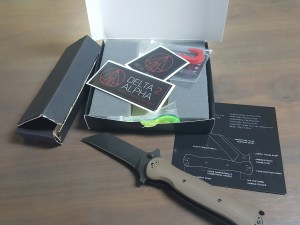
Last week I was excited to have delivered to my office Delta2Alpha’s premier folding blade, the H2 Sierra. My first impression after unpacking it was this: this is an impressive, serious blade. What I mean is that you can just tell this knife was made by serious people, for serious people. It is not some “just good enough” type of thing you’d find in your standard megastore. It’s not even the kind of thing you’d find in your standard sporting-goods or outdoors store.

Veterans of the Vietnam War have strong opinions of the fighting qualities of their adversaries. Some of them are open in their admiration for the enemy; other less so, even to the point of contempt. Some veterans consider them to be masters of deception, discipline, and skill; others scorn such talk as propaganda fueled by a hostile press and an ignorant public. The truth may be somewhere between these extremes. The VC and NVA may not have been the supermen legend made them out to be, but it cannot be denied that they won the war. Clearly they must have been doing something right.
 Quintus Curtius
You must be logged in to post a comment.