
Of Cowardice And Magnanimity

The philosopher and naturalist Theophrastus of Eresos succeeded Aristotle as head of the Peripatetic school; and while he may not have had his predecessor’s visionary profundity, he more than compensated for this with a genial manner, relentless curiosity, and a genius for organization.  Like the Prussian naturalist Alexander Von Humboldt, there was nothing in the heavens or on the earth that escaped his attention; and his exhaustive botanical treatise, the Historia Plantarum (Study of Plants) remained an authority in the field until well beyond the medieval period.

Continue reading

An Eclipse Confirms General Relativity

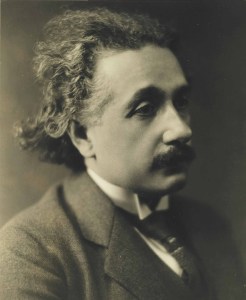
Albert Einstein’s general theory of relativity, first published in 1915, proved to be a revolutionary way of looking at the universe.  The three dimensions of space were combined with time to create a unified whole; and this space-time grid, instead of being fixed and static, could be warped in certain circumstances.

Continue reading

George Washington’s Leadership Qualities

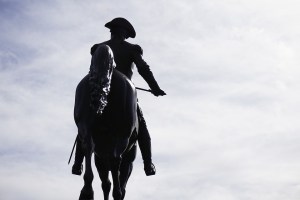
George Washington generally preferred a restrained style of leadership.  By this I mean he was economical with his words, careful in doling out both praise and recriminations, and mindful that his actions would resound more loudly with subordinates than his statements.  He understood the principle that, when leading men, sometimes a leader had to turn his back on them; he did not strive for back-slapping familiarity, but instead the calm and steady application of discipline and objective.

Continue reading

Conscience As The Theater Of Virtue: The Justice Of Saladin

I very much like the following maxim of Cicero’s:

Nevertheless, no theater for virtue is greater than one’s conscience. [1]

What he meant by this was that one’s own conscience should guide the performance of good works.  He was expressing his disapproval of those who did things for the purpose of gaining public favor, instead of following that inner voice which represents man’s instinctive sense of justice.  What should be paramount in one’s mind are not specious public displays, or a craving for shameless notoriety; what should be controlling are the dictates of one’s own conscience.

Continue reading

Washington’s Debts, And The Necessity Of Tact

George Washington was keenly aware of the psychological pressures of being in debt.  He once advised a nephew on the subject:

Continue reading

On The Death Of Seneca

There is a preparatory plaster statue, very finely executed by Eduardo Barrón, on display at the Museo Nacional del Prado Museum in Madrid.  It is called Nero and Seneca, and it was completed in 1904.  Barrón never produced a final version in marble or bronze; and although it remains a preliminary study, it is a powerfully evocative depiction of two strong personalities.  Seneca points at a passage in an unrolled book before him, and is leaning towards Nero, evidently to make some pedagogic point.  The young Nero, whom Seneca had the misfortune to tutor, remains slouched in his chair, a clenched fist pressed against his temple in sullen opposition to the lesson his teacher is attempting to expound.

Continue reading

The Roman Gestures Of The Clenched Thumb, And The Turned Down Thumb

The meaning of hand gestures may vary widely from culture to culture.  In the modern West, approval is popularly expressed by the “thumbs up” sign, and disapproval by the downward turn of the thumb.  These hand gestures even seem to be universal, at least in the modern era.  But perhaps it was not always so.  The humanist Angelo Poliziano’s Miscellanies contains a passage in chapter 42 of his book that raises some doubts, at least to my mind.  Philology may shed some light on the subject.

Continue reading

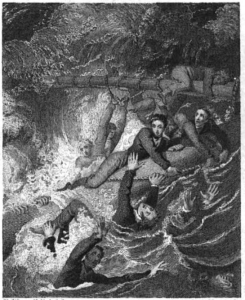
A Dog’s Heroism During The Wreck Of HMS “Harpooner”

Whether our canine friends risk themselves out of a conscious sense of duty, or whether they act out of blind instinct, is a question that dog lovers and animal behaviorists will endlessly debate.  It is not an unimportant question.  For if it is true that dogs may, under some circumstances, feel the pull of obligation, then it must follow that they are capable of the noblest emotions, and the stirrings of dutiful love.  This was the question that the following sea-story raised.  Buried in a volume of forgotten nautical lore, it describes the heroics of a service dog named King during the wreck of the British transport Harpooner in Newfoundland in 1816.

Continue reading

Some Observations On Responses To Disease Epidemics In The United States In The Eighteenth And Nineteenth Centuries

Disease epidemics are not new to the American scene.  In fact, of all the historic threats to national and local security, they are the type with which we probably have the most experience.  During the eighteenth, nineteenth, and early twentieth centuries, the United States faced and dealt with outbreaks of scarlet fever, yellow fever, cholera, smallpox, tuberculosis, malaria, and influenza.  And while the innovations of medical science were often insufficient to banish these plagues, the people handled such infections with the tools available at their disposal.  National economic life did not grind to a halt; communities were not paralyzed by fear; the press did not consciously stoke the flames of hysteria; and the political system did not descend into bickering, factionalism and recrimination.  Diseases were understood to be part of the natural order of things, to be confronted with resolution and grim determination while the rhythms of life continued to strum.

Continue reading

The Tomb Of The Scipios

When one considers the veneration that the ancient Romans had for their ancestors, it seems incredible that the tomb of the Scipios—one of the city’s most illustrious families—should be shrouded in such neglect and mystery.  And yet this is precisely the case.  One senses that the family and the city endured a bitter divorce, from which each emerged with an implacable hostility to the other; Rome never forgave the family’s recalcitrance, and punished it with a sullen historical silence.

Continue reading