
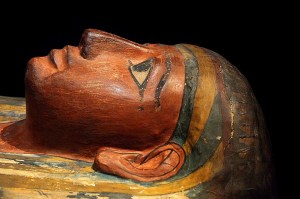
This podcast is a reading of A. Conan Doyle’s tale of the supernatural, “The Ring Of Thoth.” First published in 1890, it recounts the horrific consequences of an ancient Egyptian priest’s discovery of the secret to eternal life.
This podcast is a reading of A. Conan Doyle’s tale of the supernatural, “The Ring Of Thoth.” First published in 1890, it recounts the horrific consequences of an ancient Egyptian priest’s discovery of the secret to eternal life.

In the year 357 A.D., twenty-seven years after the empire’s capital had been moved to Constantinople, the emperor Constantius II visited Rome. He was awed by its architectural splendor, which at that time was still substantially preserved. He visited the center of the city and the extensive suburbs; the sanctuaries of Tarpeian Jove, “transcendent to the same extent as heavenly things rise above those of earth” (quantum terrenis divina praecellunt); the extensive baths; the amphitheatres; the immortal Pantheon, “arched in high grandeur, like a smooth neighborhood” (velut regionem teretem speciosa celsitudine fornicatam), and whose lofty niches were still adorned with the statues of former emperors; the Forum of Peace; the Oleum; and all the other brilliant monuments of this venerable jewel of a city.

When you are leading, you have to make the big decisions. You have to make the call, not sit back, judge the prevailing winds, and cover your ass. If you are unwilling to put yourself on the line, you are a worthless leader and have no business being there. In this podcast, we discuss:

The writer and scholar Yamut Ibn Al-Muzarra’ (يموت ابن المزرع) was a native of Basra, Iraq. In the words of his biographer Ibn Khallikan, he was known as “an accomplished literary scholar, and well-versed in history.” His name (Yamut) was a source of some consternation for him as a young man, for it is the third-person active form of the Arabic verb “to die” (مات). He apparently never fulfilled his obligation of visiting the sick in hospitals, for fear that his name would bring misfortune upon patients confined to bed. “The name,” he said, “which l received from my father has been a great annoyance to me. So when I go to visit the sick and am asked my name, I answer, ‘The son of Al-Muzarra,’ and suppress my real name.”

This podcast is a reading of H.G. Wells’s short story “The Door In The Wall.” Published in 1911, it is considered one of his finest short pieces. It describes a young boy’s discovery of a secret door that led to an enchanted land, and the effect that this secret revelation had on the rest of his life.

There is a preparatory plaster statue, very finely executed by Eduardo Barrón, on display at the Museo Nacional del Prado Museum in Madrid. It is called Nero and Seneca, and it was completed in 1904. Barrón never produced a final version in marble or bronze; and although it remains a preliminary study, it is a powerfully evocative depiction of two strong personalities. Seneca points at a passage in an unrolled book before him, and is leaning towards Nero, evidently to make some pedagogic point. The young Nero, whom Seneca had the misfortune to tutor, remains slouched in his chair, a clenched fist pressed against his temple in sullen opposition to the lesson his teacher is attempting to expound.

In this podcast, I read two short poems by William Butler Yeats: “Sailing to Byzantium” and “The Lake Isle at Innisfree.” Listen, relax, and let your mind roam to some other place.

One of the myths associated with the foundation of Rome was that of the reconciliation between the Romans and the Sabines. This took place through the mediation of the Sabine women, who, after having been abducted by the Romans, grew tired of conflict and longed for peace. The kings of the two tribes—Romulus for the Romans and Titus Tatius for the Sabines—held a conference at a location where a battle had recently been fought between the two sides. Their purpose was to unify their two nations.

This podcast is a reading of A. Conan Doyle’s terrifying tale “The Brazilian Cat.” First published in 1898, the story describes the ordeal of a young heir to a fortune who is deliberately locked in a cage with a ferocious jungle cat by a sinister relative determined to murder him.

The meaning of hand gestures may vary widely from culture to culture. In the modern West, approval is popularly expressed by the “thumbs up” sign, and disapproval by the downward turn of the thumb. These hand gestures even seem to be universal, at least in the modern era. But perhaps it was not always so. The humanist Angelo Poliziano’s Miscellanies contains a passage in chapter 42 of his book that raises some doubts, at least to my mind. Philology may shed some light on the subject.
 Quintus Curtius
You must be logged in to post a comment.