
Here are some of the latest viewings.
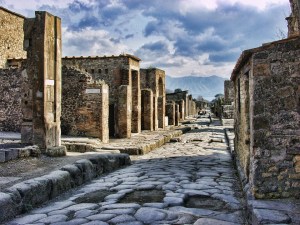
Sometimes an accident of history can preserve records of great value. As is well-known, Mount Vesuvius in Italy erupted in 79 A.D. entombing the towns of Pompeii and Herculaneum in ash and ejecta. In the eighteenth century, these sites began to be explored in a random and haphazard manner; one of the villas so discovered turned out to be the residence of a dedicated scholar.

The following articles were the most popular at the site in 2018. There are some surprises here. For the first time since the site was founded in 2015, a podcast made it to the top ten list. And not just one podcast, but two of them. They were “The Surrealistic World of Michael Porfirio” (at no. 3) and “The Porfirio Effect” (at no. 9). I much appreciated Michael’s feedback in these podcasts, and I’m glad that readers also found them enjoyable.

The poet Nasrallah Ibn Abdallah Al-Qalaqis (نصر اللّه بن عبد اللّه القاضي الأعزّ ابن قلاقس) was born near Alexandria, Egypt in 1137. He was a master of language and a composer of many exquisite verses, and was also an intrepid traveler. The name by which he is generally known (Ibn Qalaqis) is derived from the Arabic word for colocasia, a plant cultivated in his day for its medicinal qualities. His biographer tells us (with a twinkle in his eye) that “He had so little beard that his face was quite bare and, for that reason, verses were composed against him, which I abstain from mentioning on account of their indelicacy.” One wishes that these lampoons might have been preserved, if only to see how little insults have changed over the centuries.
The Roman writer Aulus Gellius relates an anecdote about his discovery of the meaning of an old proverb. He tells us that he read the following line in one of the speeches of Marcus Cato Censorius:

The poet Mihyar Al Daylami (?–1037) came from that region of Persia which bordered the southern shores of the Caspian Sea. He wrote in Arabic, and his works were so copious that his biographer says they filled four volumes. He was originally a Zoroastrian, but converted to Islam around the year 1003 under the influence of one of his professors.
A reasonable amount of experience in life teaches us that we are often the source of the wrongs that fall upon our shoulders. This is not always true, of course; but even a short period of honest reflection will reveal to us, if we examine the details of things, that we might have handled some situations better than we in fact did. Learning does not take place without honest examination; and the first person who is in need of this honesty is ourselves.
I didn’t really know what to call this podcast. It’s a mix of a few different things. I wanted to talk about the movies I reviewed in the last post here, but I also wanted to toss out an interesting comment made by Samuel Johnson on trade and pleasure. And finally–to relax and unwind a bit–I read a few recent tweets by the G Manifesto (@MichaelPorfirio). It’s important in life to mix things up. Idleness may be the Devil’s servant, but so is monotony.
Here are some of the more interesting choices of the past few weeks. Watching movies is much like trying new dishes: you just have to “consume” them and judge for yourself.
Fortress of the Mind Publications is pleased to announce that Sallust: The Conspiracy of Catiline and The War of Jugurtha is now available in a beautiful hardcover edition on Amazon and all other major book retailers. With extensive annotations, maps, photos, indexes, chronological tables, and an acclaimed introduction, this is a book designed to last for generations. Fully outfitted for comprehension and efficient referencing, this book–like all of Quintus Curtius’s translations–is a self-contained unit and requires no previous familiarity with the subject matter. It can be read and enjoyed by anyone, not just specialists.


 Quintus Curtius
You must be logged in to post a comment.