To The Man Of Virtue, All Soil Is Native

There is a line in Statius’s Thebiad (VIII.320) which reads,

Omne homini natale solum.

This means, “All soil is native to man.”  I think it is appropriate to interpret soil in an abstract form, and understand it as signifying land.  He does not mean just any land, but terra incognita: the vast expense of the unknown, untamed and hostile. Does this line have any significance, or is it just another poetic garland?  To me the poet is trying to communicate the idea that, for the brave man, every piece of ground on this earth may be claimed as his own, and called his own; and that, through his discipline and efforts, the man of virtue may conquer the challenges of his environment, wherever the locale may be. 

Continue reading

Swords And Years

There is an anecdote found in Valerius Maximus (VI.2.10) that calls our attention to the difference between the respective powers of raw force and steady patience.  A brutal consul named Cnaeus Carbo was threatening to put the city of Placentia under siege.  He ordered a city magistrate named Marcus Castricius to give him hostages as part of his campaign of destruction. 

Continue reading

On The Impudence Of Servants

There is an unintentionally amusing passage in a letter Petrarch sent to his brother Gherardo in 1349.  In it, the harried scholar pours out his frustration at the antagonistic and insulting behavior of his servants:

Continue reading

On The Collapse Of Friendship

Some of our most painful experiences can be the unexpected dissolution of friendships once thought to be robust and dependable.  The memories of shared joys persist, troubling our consciences with conflicting and perplexing emotions.  How did the collapse happen?  What degree of culpability do I share in this outcome?  What, if anything, might have been done differently?  These thoughts, and many more like them, haunt and oppress our retrospective inquiries.

Continue reading

There Is No Place Which Armed Ambition And Avarice Cannot Reach

The Italian scholar Petrarch spent a significant period of time in southeastern France as a boy and a young man.  In 1311, when he was seven years old, he moved to Avignon with his family; in 1312, he moved to the small town of Carpentras and remained there until 1316.  During other periods of his life from the 1330s to the 1350s, he chose to reside in what is now the French department of Vaucluse. 

Continue reading

Words Do Not Retreat

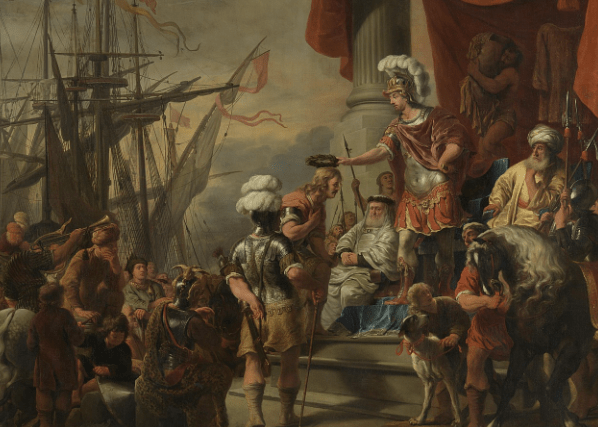
There is an anecdote told about the prelude to the Battle of Issus in 333 B.C.  This momentous contest, which involved the armies of Alexander the Great and Darius III of Persia, was to decide the fate of Asia. 

Continue reading

The First Fruits Of Virtue And Character Are To Displease The Corrupt And Ignorant

In the 1340s the Italian scholar Petrarch composed a long letter to the poet Homer.  He enjoyed these imaginary exercises in which he could “communicate” with some of the great literary figures of the past; there exist letters to Cicero, Livy, and some other ancient writers.

Continue reading

On The Death Of Seneca

There is a preparatory plaster statue, very finely executed by Eduardo Barrón, on display at the Museo Nacional del Prado Museum in Madrid.  It is called Nero and Seneca, and it was completed in 1904.  Barrón never produced a final version in marble or bronze; and although it remains a preliminary study, it is a powerfully evocative depiction of two strong personalities.  Seneca points at a passage in an unrolled book before him, and is leaning towards Nero, evidently to make some pedagogic point.  The young Nero, whom Seneca had the misfortune to tutor, remains slouched in his chair, a clenched fist pressed against his temple in sullen opposition to the lesson his teacher is attempting to expound.

Continue reading

The Font Of Life And Leadership

How often do we really think about time, and our interactions with it?  We know that Augustine of Hippo, in his Confessions (XI.20), expended significant effort on the nature of time, and its effect on human affairs.  In his view it was not accurate to say, as we normally do, that the three “times” are past, present, and future.  The better way of understanding our perception of time, he says, is to observe that the three “varieties” of time co-existing in our souls are the following:

Continue reading

The Monkey Atop The Ship’s Mast, And How To Deal With Him

A nineteenth-century volume of nautical lore provides the following story of a strange incident at sea.  In 1818 there was a ship—its name is not recorded by the tale’s author—on its homeward voyage from Jamaica to Whitehaven, England.  One of the passengers was a young mother with her infant child, who was only several weeks old.  One day, the ship’s captain saw something on the horizon, and offered his spyglass to the mother, so that she might for herself see what it was.  She wrapped her child in her shawl and placed it carefully on the seat where she had been sitting.

Continue reading