Take The Initiative And Do The Unexpected


Your enemies are slothful, satisfied, and unwilling to tolerate pain and discomfort.  They wish to be comfortable, to enjoy their privileges, and to spend their days in leisure.

They would rather hate on you than do any work to improve themselves.

They are cozy in their little domains.  You, on the other hand, are willing to head out into the wasteland:

Your enemies are afraid of the wasteland.  But you embrace it.  You have conquered your fear of it.  You are willing to do what is necessary, unlike them.  And this is why you will triumph, and they will not.  Take the initiative, and keep moving.

Several examples illustrate this point.

Continue reading

The Fable Of Aridaeus of Soli

air

Plutarch’s essay On God’s Slowness to Punish (563C et seq.) relates a vivid fable on the punishments meted out to those to commit evil acts in their lives.  It also relates to us the requirements and possibilities for moral redemption.

The fable takes the form of an out-of-body experience that has much to say about ethics and human responsibility.  But it is parable rich in metaphor and meaning.  Readers can interpret it in a variety of ways.

This is the story.

There was a native of the town of Soli named Aridaeus.  He indulged himself in every type of sensual and mortal passion that he could, and was undeterred by the effects that these pursuits caused to others.  He quickly exhausted his money, and turned to a life of crime.  His sole motivation was profit and gain.

Continue reading

Great Leaders Usually Emerge In Crises

The current batch of presidential candidates leaves me feeling nothing. I don’t feel inspired by any of them. I don’t feel interested in any of them. All I feel is…nothing, a generalized emptiness that edges into contempt.

All of them are complete nothings, nonentities.

You may feel the same way. When it comes to politics, disappointment is now so routine that we simply take it for granted. None of the candidates has anything positive to offer. All they are offering is a continuation of the same tired old policies.

[To read the rest of my article at Return Of Kings today, click here].


Seeking Peace Of Mind: A Letter

peace3

We cannot always choose our circumstances, but we can adapt our minds and attitudes to the circumstances we are presented with.  Plato, in the Republic (604c5 ff.), famously compared life to a game of dice that was structured at two levels:  the throw of the dice (over which we have no control), and the way in which we deal with the results of the throw.  This same dice analogy is found in Epictetus (II.5.3).  Our attitudes mold our lives.  If we do not adapt our attitudes to our circumstances, we will be like the man who carries a hidden sickness wherever he goes.  He travels here and there, always seeking a better environment, but he finds himself equally miserable wherever he is.  Why is this?  It is because the problem lies in his mind.

Continue reading

Some Thoughts On The Use Of Words, Gathered While Eating Bolinhos De Bacalhau


I was sitting last night (and early this morning) at a locally well-known restaurant in Rio de Janeiro named Cervantes (it’s in Copacabana, near Leme).  I was eating some of the best bolinhos de bacalhau I had ever had, and talking with a girl I’ve known for a while here.

As the flow of the conversation in Portuguese progressed, and as I added more red pepper sauce to my bolinhos, I began to think more about words, language, and their uses.  A few glasses of beer also helped.  I thought it might be useful to commit some of those thoughts here.

Continue reading

Your Defiance Is Your Abundance

def1

We hear a lot, here and there, about creating a “mentality of abundance.”  We read much about how we need to create an “abundance mindset.”

Abundance!  Abundance!  Abundance!  Scream the hype-men, the carnival-barkers, the chest-beaters.  It is a tiresome pantomime.  All under the circus big-top.

Step right up, ladies and gentlemen!  

Which is fine, as far as it goes, I suppose.  I’m a firm believer in abundance, and its mentality.  I want to roll in abundance, if I can.  I want to eat and drink of it.  If I can.

Gorge myself on it.

But when I hear too much of this abundance talk, I want to grind a grapefruit into someone’s face.  I want to say to the chest-beaters and carnival-barkers:  take your abundance mentality and shove it up your ass.  I prefer a defiant mentality.  My will is my abundance. Continue reading

What Is The Best English Translation of Sun Tzu’s “Art Of War”?

My article this week at Return of Kings deals with Sun Tzu’s Art of War.  

Sun Tzu’s The Art of War is one of the most widely read of the military classics. A very large number of translations exist, of decidedly uneven quality. Some of these “translations” omit large portions of the original text’s commentary; and some of them are glossy, slicked-up books that bear little relation to the original.

As it turns out, The Art of War has much to tell us about the art of translation. The translator must know the language, of course; but he must also know his subject, and have a sensitivity to the nuances of a work’s historical context. The quality of a translation can make or break a work. A good translation can communicate the spirit of the original, while a bad one can alienate a reader permanently.

[To read the rest of my article, click here.]

The Apple Of Empress Eudocia

I came across a poignant little tale yesterday, languishing in a forgotten volume of history on the reign of the Roman emperor Theodosius II (A.D. 401-450).  The book is the Chronographia of the ecclesiastical historian John Malalas (c. 491-578).

Continue reading

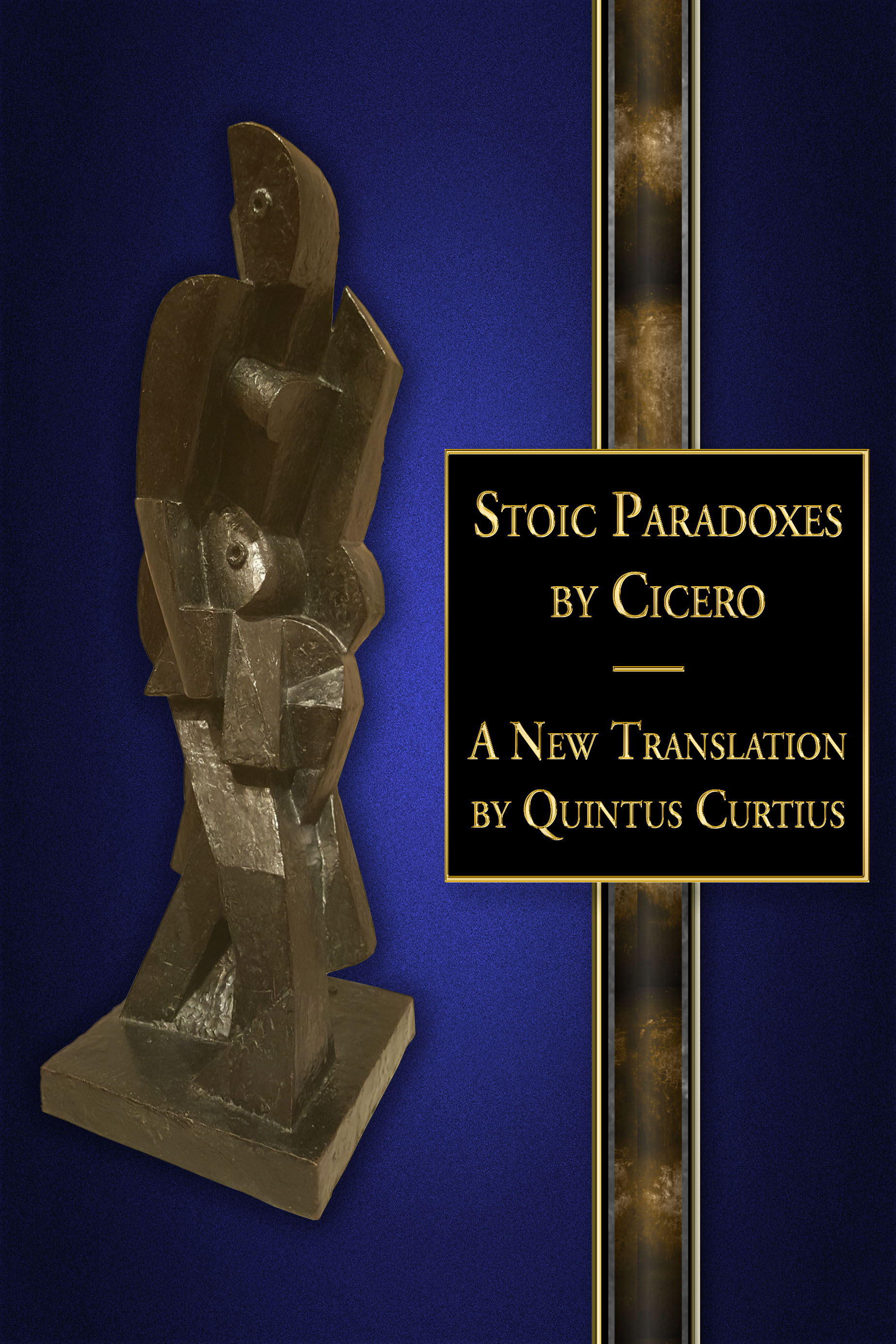
Coming This Fall: Stoic Paradoxes

stoic.para.kindle.cover

Stoicism has proven itself to be an enduring and influential philosophy.

It may not have attracted the greatest number of adherents when compared to other schools of philosophy, but the men that it did attract tended to be the best men.

Cicero, whose name is synonymous with eloquence, wrote a great deal on Stoicism.

I will be releasing a new book this coming fall.

I have decided to issue a fresh, new translation of one of Cicero’s lesser known works, a treatise called Stoic Paradoxes.

Continue reading

The Ethic Of Prison Camp Survival

prison1

One of the greatest accounts of suffering and survival that I’ve read is the book Prisoners of the Japanese by writer Gavan Daws.  It’s a compendium of anecdotes, stories, and harrowing accounts of Allied prisoners taken by the Japanese Army in the Pacific.

More than this, it is a painstakingly-assembed oral record of the men–almost all of them dead now–who lived and survived in now-forgotten hellholes like Changi Prison, Cabanatuan, the Burma-Siam railroad, Davao, and a dozen other places.

Thousands of men from the armed forces of the United States, Great Britain, Australia and New Zealand, and the Netherlands were done to death in these camps, either by disease, forced labor, starvation, or related causes.

Continue reading