

You can find a complete listing of all the articles on this site here. They are listed in reverse chronological order, and are all clickable links. Twenty-five articles are displayed per page, with the publication date included. To find older articles, click on the page numbers at the bottom.
To search the site by subject, topic, or name, you can use the “Search” function on the right sidebar.
_______________________________
-
Interview With “Classical Wisdom” On The New Translation Of Frontinus’s “Stratagems”
I had the privilege of doing a recent interview with Ms. Anya Leonard of Classical Wisdom, a publication that focuses on classical learning and education. The interview can be seen here:
-
Love, Sloth, And Free Will (Podcast)
In this podcast we discuss love, sloth, and free will in the context of Canto 18 of Dante’s Purgatorio. What is the nature of love, and how does it affect our souls? What is the true meaning of sloth? What place does free will have in our lives? We explore these questions.
-
The Strange Murder Of Madame Launay
The following crime story is found in an issue of William Evans Burton’s The Gentleman’s Magazine from 1839 (Vol. IV, January—July). It appears under the title “Unpublished Passages in the Life of Vidocq, the French Minister of Police. No. V: The Strange Discovery.” “Vidocq” refers to Eugène-François Vidocq (1775—1857), the French criminalist and investigator who…
-
Lone Founts
If someone were to ask me why I read history, my reply would be in three words: solace, advice, and examples for our edification. Let me explain further.
-
The Decline Of Poetry
Poetry is not the “draw” it once was. In the nineteenth century, it was relatively common for poetic works to be taught in schools, to be memorized in whole or in part, and to be the subject of public readings. No longer. One would today be hard-pressed to name any modern poets who have achieved…
-
The Banners Of The King Of Hell Go Forth
In the thirty-fourth canto of Dante’s Inferno, our intrepid tourists Dante and Virgil find themselves at the very bottom of Hell’s ninth circle, known as Judecca, a name derived from Judas Iscariot. With his enthusiasm for classification and categories, Dante has given us names for the different parts of the ninth circle, in which are…
-
Herman Melville’s “Battle-Pieces And Aspects Of The War”
The two greatest artistic productions to come out of the American Civil War were Alexander Gardner’s Photographic Sketch-Book of the War, and Herman Melville’s poetic masterpiece, Battle-Pieces and Aspects of the War.
-
The Zero Sum Game
I read recently a fascinating tale of nautical survival. In 1965, six teenage Tongan boys were shipwrecked on the uninhabited island of Ata in the Tongan Archipelago of Polynesia. After stealing a boat, they had encountered a storm which deposited them on the island without any means of communication with the outside world.
-
Ne Plus Ultra
Canto XXVI of Dante’s Inferno takes place in the eighth bolgia (ditch) of the Eighth Circle of Hell. Here reside those guilty of providing fraudulent or deceitful counsel. In life, these souls used their persuasive abilities to harm or destroy others; and, in keeping with Dante’s attention to the principle of contrapasso, their punishment in…
-
Give It Time (Podcast)
We begin with a few recommendations on books and resources to use in understanding Dante’s Divine Comedy. Then we switch gears, and get into the meat of the podcast. It seems we become substantially different people every seven to ten years, more or less. We may feel self-conscious or uncomfortable about the things we said,…
-
The New York City Draft Riots Of 1863
New York City, like all large cities, has experienced a number of riots in its long history. But the Draft Riots of 1863 surpassed every other upheaval, before or since, in unadulterated ferocity.
-
Heroism During The Loss Of The “Stella”
It is at moments of unremitting extremity that we discover our true natures. The tragic loss of the British ship Stella in 1899 provides an illustration of this principle. The story appears in a 1962 volume of nautical lore entitled Women of the Sea by the maritime writer Edward R. Snow; but since the book…
-
Good Men Are More Suspect Than Bad
The Roman historian Sallust, in his Conspiracy of Catiline, reminds us that
-
Rights That Have Been Won, Do Not Automatically Remain Won (Podcast)
Rights and liberties that have been won by past generations will not remain won without active and forceful advocacy by successive generations. Why? Systems of power and control will inevitably regroup and counterattack, and seek to roll back the clock. This is happening all around us now. Those who are unwilling to assert their rights,…
-
Deep Memories Yield No Epitaphs
Chapter 23 of Moby-Dick is entitled “The Lee Shore.” It offers some philosophical commentary on the need for travel and direct experience. Melville reflects on the restless, roaming nature of a sailor named Bulkington:
-
The Gettysburg Address
Let us tell the story of the greatest speech ever delivered by an American president.
-
Nowhere Is Rome Less Known Than At Rome
In a letter written to Giovanni Colonna in 1337 or 1341—scholars are uncertain of the precise date—Petrarch says as follows:
-
The Audiobook Of The New Translation Of Frontinus’s “Stratagems” Is Now Available
Fortress of the Mind Publications is pleased to announce that the audiobook of the new translation of Frontinus’s Stratagems is now available. The link to Amazon Audible can be found here. The book is read by narrator Saethon Williams, whose expert audio renditions have featured in Quintus Curtius’s other translations. Besides Amazon Audible, the audiobook…
-
Press Your White Hairs With A Helmet
In book nine of the Aeneid, the Rutulian warrior Numanus Remulus makes a famous declamation, in which he speaks the following lines:
-
You Have No Right To Turn Away (Podcast)
In an 1842 letter to Ralph Waldo Emerson, the Scottish writer Thomas Carlyle chastised Emerson, saying, “A man has no right to say to his generation, turning away from it, ‘Be Damned!’ It is the whole past and the whole future, this same cotton-spinning, dollar-hunting, canting and shrieking, very wretched generation of ours. Come back…
-
The Loss Of The “Boston,” Which Was Burned By Lightning
No one should doubt the extraordinarily destructive power of lightning. A dramatic illustration of this power occurred in 1830, when the packet ship Boston was hit by a bolt of lightning in the Atlantic and burned to the waterline, with the loss of one unfortunate passenger.
-
The Expedition Of Antoine d’Entrecasteaux
The French naval officer and explorer Antoine Bruni d’Entrecasteaux was born at Aix-en-Provence in 1739. He enlisted in the French Navy in 1754; but he must have shown promise to his superiors, for they granted him an officer’s commission two years later.
-
A Bad Omen At Sea Portends Disaster
The following story is found within the pages of an 1840 volume entitled The Book of Shipwrecks and Narratives of Maritime Discoveries and the Most Popular Voyages. The narrator of the tale, as seems to have been the custom in those days when relating first-hand accounts, has omitted some specific details, such as the ship’s…
-
The Aftermath Of Battle (Podcast)
In this podcast I describe unforgettable images that have emerged from the aftermaths of certain battles. We discuss Livy’s description of the battlefield after Cannae, a scene in Dante, and an anecdote from the American Civil War.
-
A Literary Review Of “Stratagems”
A literary review of the new translation of Stratagems appeared on the Classical Wisdom substack on October 6, 2025. The review is entitled Rome’s Lost Art of War.
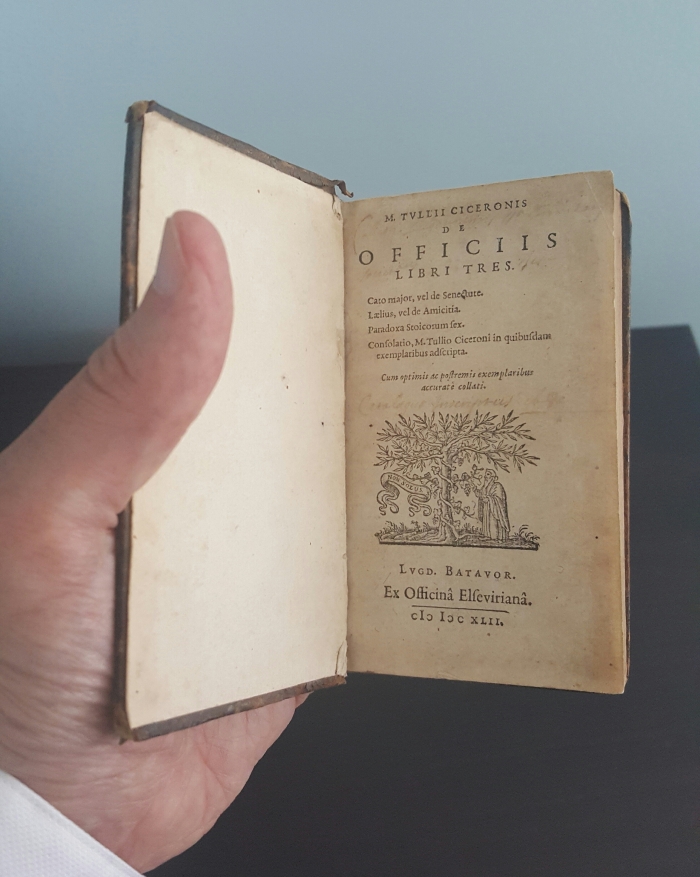
Original copy of Cicero’s De Officiis (On Duties) published in Holland in 1642. From the collection of Fortress of the Mind.
 Quintus Curtius
You must be logged in to post a comment.