
James Madison And Abraham Lincoln: Contrasts In Wartime Leadership

It will be useful to compare the leadership styles of two wartime American presidents of the nineteenth century.  James Madison was president during the War of 1812, while Abraham Lincoln occupied the office of chief executive during the American Civil War.  The first of these must be counted a failure as a wartime commander-in-chief, while the second was able to prosecute his nation’s most terrible conflict to a successful conclusion.  What qualities enabled one to emerge triumphant, and the other to suffer the indignity of failure, we will now examine.

Continue reading

The Wounded Commodore Barney Meets The British Commanders At Bladensburg

The burning of Washington [PD: US]

It is unfortunate that the War of 1812 is understudied, for it furnishes us modernly with a great many lessons on the consequences of unpreparedness and military ineptitude in defense of one’s homeland.  While the Americans scored some notable naval victories during the war, the land campaign remains a dreary record of defeat and flight, relieved only by Andrew Jackson’s impressive, but strategically inconsequential, victory at New Orleans two weeks after the treaty concluding the conflict had been signed at Ghent. 

Continue reading

Lt. Joshua Barney Escapes From England’s Old Mill Prison

The name of Joshua Barney is unlikely to be familiar with readers.  He was, however, one of the principal American naval heroes of both the Revolutionary War and the War of 1812.  We have not sufficient space here to recount his long and distinguished career as a combatant; but we will relate his daring escape from British captivity during the revolution, as it illustrates his dominant traits of resourcefulness and courage.

Continue reading

“What You Need Is Strength Equal To Theirs”

We recently discussed some words spoken by the Greek mercenary general Charidamus to the Persian king Darius III on the eve of the Battle of Issus in 333 B.C.  But we discussed only a small part of his speech.  His complete comments are worthy of our meticulous consideration.

Continue reading

The Duel Of Conway And Cadwalader

In the early years of the American Revolutionary War, there existed a loose association of military men who lacked faith in George Washington’s ability to lead the Continental Army, and who were convinced he should be replaced.  Although Washington’s position was never seriously in jeopardy, these undercurrents of discontent eventually broke through the surface, taking the form of a bizarre duel between partisans of both sides. 

Continue reading

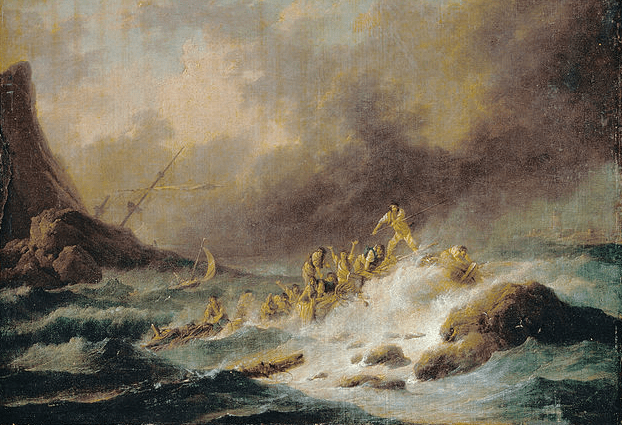
The Cruel Wreck Of H.M.S. Nautilus

The island of Cerigo, modernly called Kythira, is situated off one of the southern-jutting fingers of the Greek peninsula.  Greece’s rocky shores have without doubt claimed more than their fair share of shipwrecks; and in 1807, near the end of the Napoleonic wars, they became the scene of a terrible tale of maritime suffering and survival, which we will now relate. 

Continue reading

The Nightmare Wreck Of The “Nottingham Galley”

Would a captain deliberately wreck his own ship, or turn it over to privateers, in order to collect insurance money?  This is one of the central questions surrounding the strange and controversial story of the British merchant ship Nottingham Galley, which was wrecked off the coast of Maine in December of 1710.  It is a dark and compelling incident, one which will invite readers to draw their own conclusions as to what actually happened.

Continue reading

Into A Dark Forest

In very ancient times there was a dense, feared, and trackless forest that separated the territory of Rome from that of Etruria.  It was called the Ciminian Forest (Silva Ciminia), and it was a region that the Romans avoided. 

Continue reading

Anecdotes Related To Ya’qub Ibn Al-Laith Al-Saffar, Founder Of The Saffarid Dynasty

Ya’qub Ibn Al-Laith Al-Saffar was the founder of the Saffarid Dynasty of Sistan.  He lived from A.D. 840 to 879, and rose from humble origins in Afghanistan to conquer an immense area comprising parts of Iran, Afghanistan, Turkmenistan, Tajikistan, and Uzbekistan. 

Continue reading

The Bixby Letter

Those who have seen the movie Saving Private Ryan (1998) will recall a scene where the actor playing General George Marshall reads to his staff an eloquent and moving letter of condolence written by President Abraham Lincoln to a Mrs. Lydia A. Bixby during the Civil War.  This justly famous epistle, now known as the Bixby Letter, is reproduced below.  Who will protest at our quoting it in full here? 

Continue reading