


When Quintus Curtius’s translation of On Duties was first published in 2016, it achieved something few would have thought possible.
Cicero
The Shortness Of Life, And The Second Death

There is a passage in Cicero’s treatise Tusculan Disputations I was thinking about today while driving home from work. The passage begins as a parable, then closes with a glorious invocation to action. Cicero makes an analogy from nature observed near the River Hypanis, then draws some conclusions from that analogy. He says:
The Three Things That Deflect Us From Love

Several days ago I received a warm email from a young guy in Brooklyn who had read one of my recent articles here. The story, told in the form of a fable, underscored the importance of taking the initiative in matters of love. His questions were these: How do I know when to take the initiative? How can I develop my “initiative-taking” spirit?
Fear Or Love? The Views Of Cicero And Machiavelli (Podcast)

Is it better to be feared or loved? This famous question is more nuanced than people think, and was addressed specifically by Cicero in “On Duties” as well as by Machiavelli in his “Prince” and “Discourses.” Yet there has been much oversimplification and misunderstanding on this subject.
We also discuss whether Stoicism lends itself to passivity and fatalism.
Conduct, Obligations, And Decision-Making: Details Of My New Book “On Duties” (Podcast)
This podcast discusses my new book, On Duties. It is the most explanatory, readable, and well-organized translation of Cicero’s classic that is available in English, and perhaps in any language. In this podcast, I provide the three reasons why this is so. I also discuss the great theme running through the book: the idea of greatness of spirit.
“On Duties” Is Now Available For Pre-Order
I’m proud to announce that my new book, an annotated, fully explanatory edition of Cicero’s On Duties, is now available for pre-order. The Kindle version is available for pre-order now (with an actual release date of July 1), and the paperback version will be available on July 1 as well.
The Details On My Upcoming Book “On Duties”
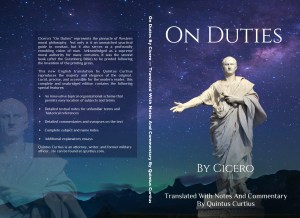
At the end of this month, I will be releasing On Duties: A Guide To Conduct, Obligations, And Decision-Making. It is an exhaustively annotated, indexed, and topically referenced translation of Cicero’s famous treatise, along with commentary and supplementary essays.
The Art Of Consolation

There used to exist a literary genre called the consolatio, or consolatory essay. It is the type of thing that would be written by one person to another on the event of some terrible personal tragedy, such as the loss of a loved one. Sometimes (e.g., in the case of Boethius) the writer simply wrote it for himself. The ancient authors recognized it as a form of oratory, but it has been out of fashion for a long time now.
Lecture On “The Dream Of Scipio”: The Out-Of-Body Experience, The Nature of Glory, And The Immortality Of The Soul

This lecture discusses Cicero’s visionary essay The Dream of Scipio which I included at the end of my book Stoic Paradoxes. It relates a philosophical conversation arising from an out-of-body experience high above the Earth.
“Stoic Paradoxes” Lecture 7: Only The Wise Man Is Wealthy

Welcome to the seventh and final lecture in our series on Stoic Paradoxes.
In this lecture, we discuss some of the most critical points of Stoic ethics:
- What is wealth?
- Who can be considered wealthy?
- Is the wise man rich? If so, in what way?
I hope you’ve enjoyed this lecture series. If so, please rate me on iTunes, and on Amazon.com, so that others may find these lectures, and enrich their own lives.
Please feel free to email also, if you have questions about any of the ideas discussed here.
This podcast was brought to you courtesy of Fortress of the Mind Publications.
 Quintus Curtius
You must be logged in to post a comment.