

The Soviet Union is no more, as everyone knows. Its political system proved to be unsuccessful; it was incapable of adapting to the challenges of history.
The Soviet Union is no more, as everyone knows. Its political system proved to be unsuccessful; it was incapable of adapting to the challenges of history.
Janusz Bardach’s Man Is Wolf To Man: Surviving The Gulag ranks among the best prison-camp memoirs of the Second World War era. As an epic of suffering and survival, it makes an excellent companion to Siegfried Knappe’s Soldat: Reflections Of A German Soldier, 1936-1949, another dark chronicle of a dark era.

I had a chance yesterday to learn more about a strange and tragic incident in recent Brazilian history: the country’s so-called “rubber soldiers” (soldados na borracha) program of the Second World War. The story is almost totally unknown in the United States, and for this reason I thought it would be worthwhile to share some details about it here.

Many decades before 1453 (the year Constantinople finally fell to the Ottoman Turks), the Byzantine “Empire” had become a sad parody of its former self. Mismanagement, bad leadership, and the inability of the old state to cope with the challenges of its strategic environment had fatally doomed it long before Ottoman cannon breached its walls.

A news agency recently reported the discovery of the tomb of Suleiman the Magnificient, who by general consensus was the greatest of all the Ottoman sultans. Suleiman, who lived from 1494 to 1566, is now nearly unknown in the West; but he was, in the words of one eminent historian, “the greatest and ablest ruler of his age.”
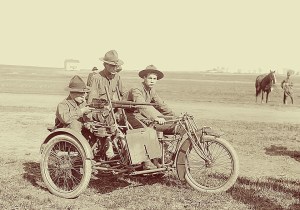
Today we take for granted the fact that infantry units are equipped with all sorts of portable firepower. Squads carrying light machine-guns are accepted as natural and part of the battlefield equation. But it was not always so.
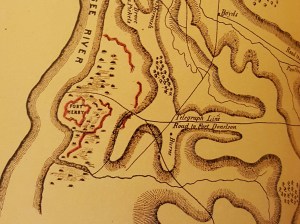
War brought out the bulldog in U.S. Grant. A decent man but a failure in civilian life, he was good at one thing, and one thing only: war. His method was to hone in on his enemy, get in close, and figuratively grab him by the belt to keep him close. So positioned, he would then hammer away at his opponent relentlessly. He may not have had the panache and elan of some of his more exalted (or overrated) contemporaries, but he did have a quick mind that could grasp the military essentials of situations in ways that very few others could.

There is a scene in the 1987 film Wall Street when the Charlie Sheen character (Bud Fox) is about to meet the formidable Gordon Gekko (Michael Douglas). He says to himself, “Well, life all comes down to a few moments. This is one of them.”
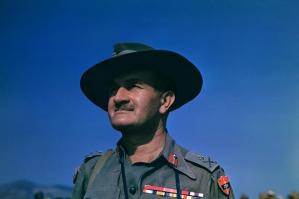

At the conclusion of his memoirs, General William Slim, the British commander in the Second World War’s Burmese and India theaters, had some pungent observations on the conduct of the war and its ultimate outcome. Originally defeated in the field, he came back to hammer the Japanese decisively in some of the most remarkable ground combat of the entire Pacific War.

The armies of the belligerents who went to war in 1914 carried rifles that today might be considered quaint. They had handsome wooden finishes, were designed for long-range fire, and were so robust that they could withstand all manner of abuse in the harsh trench environments in which they were used.
[To read the rest of article, click here.]


 Quintus Curtius
You must be logged in to post a comment.