In this podcast we cover travel tips and impressions learned from my recent trip to Athens. The following areas are covered:
In this podcast we cover travel tips and impressions learned from my recent trip to Athens. The following areas are covered:

When a man is under the duress of extreme events, he sometimes finds himself wracked by indecision. He will mull over various courses of action in his head; he will script out different scenarios in his imagination; and he will ponder his predicament from multiple perspectives. And yet, when he has finished with these troublesome cogitations, he may find a course of action still eludes him; but at some point, a moment of inspiration will arrive to pierce the gloom, and confer on him the guidance he has desperately been seeking. When this happens, he must unhesitatingly seize the present hour for action, and proceed with his rendezvous with Fate.

I was recently interviewed by Online Great Books regarding different aspects of my translating and writing work. It was a great discussion.
The interview can be found here.
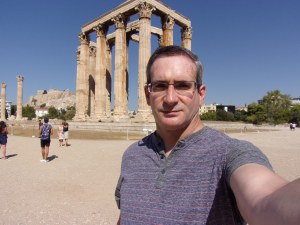
A short distance south-east of the Acropolis are the remains of a colossal temple called the Olympieion, or the Temple of Olympian Zeus. It was begun around 520 B.C. with the expressed purpose of being the largest and most impressive such structure in the Greek-speaking world, but it fell victim to political fortunes. Work on the temple was abandoned around 510 B.C. when one of its advocates, Hippias, was removed from power and expelled from Athens.
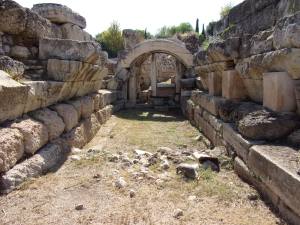
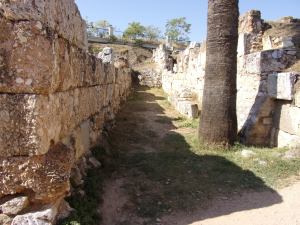
Today I visted a site called Kerameikos in Athens. It was a cemetery for many centuries, and contains numerous examples of funerary art. The site was only rediscovered in 1861 during road construction in the neighborhood. On the site is also located the famous Dipylon Gate, which was the main entrance into Athens during ancient times when the city was surrounded by walls. The gate itself is said to have been the largest gateway in the ancient world, covering around 1800 square meters. Constructed around 478 B.C., it had four large covered towers and a courtyard that also served as an official meeting place and a location for commercial activity. I was excited to see the remains of the Gate, as I had read references to it in classical texts.
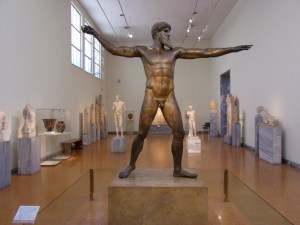
I have spent the past two days in Athens seeking out some of the monuments of classic Greek art. I have tried to see as many works of art and architecture as was reasonably possible, and thought I would here provide the impressions gained from these observations.
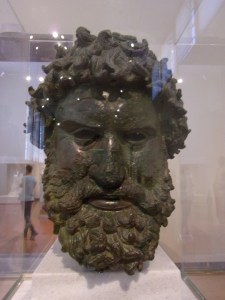
Today I visited the National Archaeological Museum in Athens, as well as the historical site of Aristotle’s Lyceum. The Lyceum was the place of origin of Aristotle’s Peripatetic school of philosophy, which took shape around 335 B.C. Like the Platonic Academy, there is not much in the way of physical remains; but this did not matter to me at all. Just to be able to stand on this ground was to me worth the effort in coming to Greece. It was only discovered in 1996. How often do we read of Aristotle, and yet no one bothers to link a physical location to his memory? This is why it was important for me to take these pictures, and show them to readers here.
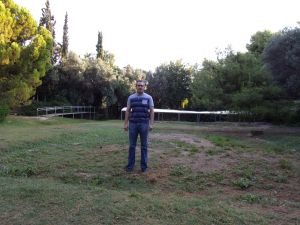
I walked to the ruins of the Platonic Academy in Athens this morning. Founded by Plato himself around 387 B.C., it persisted through many generations under a variety of scholarchs (i.e., heads). It finally came to an official end during the reign of the emperor Justinian in 529 A.D., who ordered the closure of all the pagan institutions of higher learning.
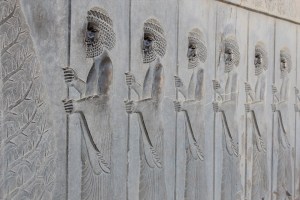
There is a line in one of Seneca’s letters (107.11) that reads:
Ducunt volentem fata, nolentem trahunt.
Seneca is quoting a line by the philosopher Cleanthes, which means, “The fates lead along the willing, and carry along the unwilling.” It does not matter whether we want, or do not want, to move in some direction; we will be brought there by the operation of Fate. Of course there are many who will say that this is nothing but a crude fatalism that promotes resignation and apathy. Carried to excess, the idea does lend itself to these sentiments. On the other hand, I am sure that there are many who can confirm that, in some cases, doing nothing is better than constantly straining to force a certain outcome.
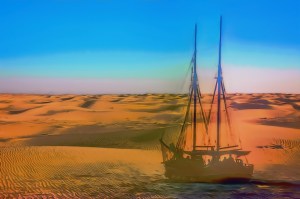
Perhaps it is well that the modern traveler remains serenely unaware of the extraordinary hardships endured by his itinerant ancestors. For if he knew what travel in the pre-modern era truly entailed, he would be rightfully consumed by a sense of shame and inadequacy. His concerns are whether he will have the chicken or the pasta aboard Delta Flight XYZ bound for one city or another; his ancestors, however, were grateful just to get a few moldy biscuits and rum during some miserable transoceanic ordeal. Perspective is everything, or nearly everything.
 Quintus Curtius
You must be logged in to post a comment.