
Seeking One’s Fortune, And Meeting George Washington

vista

François-René de Chateaubriand (1768-1848) was a French writer, diplomat and historian famous for his posthumous autobiography Memoirs from Beyond the Tomb.  The book is appealing for its admixture of blunt honesty and romantic reflection that capture the spirit of the times in a way that enables the reader to feel he is a participant himself.

Continue reading

The Ship Of Aeneas: A Unique And Mysterious Vessel

ship3

In life and in history, there are a great many things we do not know, and will never know.  Corporeal images recede slowly into the mist:  some to return, some to glimmer faintly without revealing tangible form, and some never to be seen again.  It is the way with things.

Continue reading

The Chilling Origins Of The “Sardonic Laugh”

sardinia2

One of the great things about history, literature, and philosophy is that these subjects have the ability to take us down dark rabbit-holes every now and then.  I think H.P. Lovecraft once said something like “seekers after knowledge haunt strange and dark places.”  I can’t remember the exact quote, but it was along these lines.  I was reminded of just how dark these can be last night as I was going through Procopius’s History of the Wars (a regular companion of mine for some months now).  Anthony Kaldellis’s wonderful edition of this neglected work proves once again that the right translation of a work can make all the difference in whether a book blossoms into life or falls flat.

Continue reading

You Need Redundancy And Back-Up Systems

pipes1

From the years 540 to 562, the Eastern Roman Empire under Justinian was engaged in a drawn out struggle against the Sassanid Persians under Chosroes (Khosrow).  This contest is usually called the “Persian War.”  Many illuminating incidents that happened during this conflict I have used in previous articles here.  Another one highlights the need for redundancy and “back-up” systems as security in times of trouble.  We are aware of this principle when it comes to computing and software, but it can be applied to many other fields of activity.  The following story demonstrates this principle.

Continue reading

James Webb On The Fighting Abilities Of The Viet Cong And NVA

vc3

Veterans of the Vietnam War have strong opinions of the fighting qualities of their adversaries. Some of them are open in their admiration for the enemy; other less so, even to the point of contempt.  Some veterans consider them to be masters of deception, discipline, and skill; others scorn such talk as propaganda fueled by a hostile press and an ignorant public.  The truth may be somewhere between these extremes.  The VC and NVA may not have been the supermen legend made them out to be, but it cannot be denied that they won the war.  Clearly they must have been doing something right.

Continue reading

An Epitaph For Fidel Castro: The Failure Of Self-Mastery

fidel1

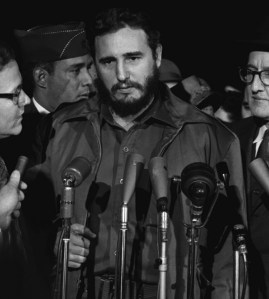
He was from youth a strong-willed and charismatic man, certain of the correctness of his ideas and the importance of his mission. It is probably true that in the beginning he genuinely wanted the best for his country, and he was possessed of a burning desire to right the wrongs he saw all around him. Cuba under his predecessors was little more than a huge plantation, exploited at will by corrupt elites and foreign powers.  His certitude gave him a charisma which the credulity of the commons mistook for leadership.

Continue reading

An Unexpected Consequence Of The Crusades

crusades1

On the subject of the results of the Crusades, much has been written.  The effects were profound and stimulating, practically too numerous to be mentioned here.  At that time, Europe was behind the East in arts, knowledge, and refinement.  Edward Gibbon tells us:

Continue reading

The Fate Of A Collaborator

dreams4

At one point in the Gothic War during the reign of Justinian, the Romans (or as we would now call them, “Byzantines”) under Belisarius were besieging a Gothic garrison at the town of Osimo in Italy.  The blockade of the town was very effective, and the inhabitants had been reduced to eating almost anything to stay alive.  But they were hoping to get some relief from the siege; their plan was to beg the Gothic commander Vittigis at the city of Ravenna to come to their aid.

Continue reading

Unusual Battle Injuries In Ancient Combat

javelin1

The historian Procopius relates some unusual combat injuries of the Gothic War, which took place from 535 to 554 A.D. as part of the emperor Justinian’s attempt to bring back the Italic peninsula and its environs back into the Roman fold.  A few incidents stand out as worth of relation here.  In our modern age of firearms and high-velocity projectile weapons, we forget that battlefield wounds from swords, javelins, and spears had their own bizarre qualities.

Continue reading

Any City Can Be Taken

aqua1

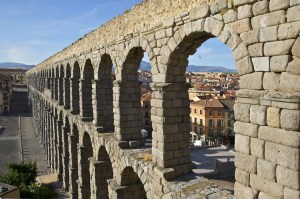
Any fortress can be stormed, and any city can be taken.  It is a matter of using the correct tactics, combined with daring and imaginative leadership.  Some citadels fall to guile, and others to brute force; still others yield to a combination of the two.  We will consider the fall of Naples, an event that took place during the Gothic War (A.D. 535-554).  This was one of the emperor Justinian’s wars to reassert imperial control over Italy from the occupying Goths.

Continue reading