
This is a cold time of the year where I live. Sometimes I’m reminded of the time I spent in Korea many years ago, and of the great food I used to eat there.
I like to haunt Asian food stores every now and then, to take me back to the old days.
This is a cold time of the year where I live. Sometimes I’m reminded of the time I spent in Korea many years ago, and of the great food I used to eat there.
I like to haunt Asian food stores every now and then, to take me back to the old days.
In early January 2016 I’ll be releasing a new book called Pathways.
It is a collection of my best essays from 2015, and includes more than 50 separate essays.
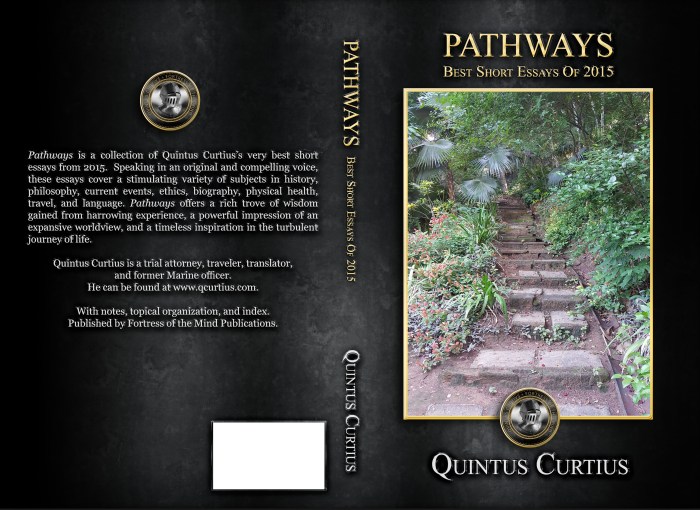
Many of these have been enlarged, expanded, or edited. These are the definitive versions of my best essays from 2015.

This lecture discusses Cicero’s visionary essay The Dream of Scipio which I included at the end of my book Stoic Paradoxes. It relates a philosophical conversation arising from an out-of-body experience high above the Earth.

Welcome to the seventh and final lecture in our series on Stoic Paradoxes.
In this lecture, we discuss some of the most critical points of Stoic ethics:
I hope you’ve enjoyed this lecture series. If so, please rate me on iTunes, and on Amazon.com, so that others may find these lectures, and enrich their own lives.
Please feel free to email also, if you have questions about any of the ideas discussed here.
This podcast was brought to you courtesy of Fortress of the Mind Publications.
Happy Thanksgiving! I hope the next few days will be a time for reflection and relaxation.
And thanks for joining us in our next lecture on Stoic Paradoxes. In this lecture, we discuss some of the most critical doctrines in Stoic ethics:
Fortress of the Mind Publications brings you the fifth lecture in our series on Stoic Paradoxes.
In this lecture, we discuss the following proposition: misdeeds are equal, and good deeds are equal.
Is this true? If so, to what extent? And what does it mean for us?
Join us here (for SoundCloud) or here (for iTunes) to find out the answers…
This is our fourth lecture on Stoic Paradoxes
In this 15-minute lecture, we get into the book proper, with a discussion of the book’s first two propositions:
You can listen to the podcast by clicking here.
By the time you’ve gone through my book and we conclude this lecture series, you will know Stoicism better than any college professor.
Brought to you courtesy of Fortress of the Mind Publications.
Every man’s character has a dual quality to it. One quality is etched into every man’s consciousness from birth, more or less. And this is the quality of reason that Nature herself has endowed us with; it is that which separates us from the unreasoning brutes.
It is a universal quality, in the sense that every man possesses it. From this rational aspect we get our innate sense of justice and fairness. It is also what gives man that special curiosity about the world: it is that which impels him to make inquiries into everything, to investigate everything, and to try to find answers for the riddles of Nature.

The armies of North Korea burst into South Korea in June 1950 and quickly overwhelmed its forces, confining them to a perimeter around the city of Pusan. Douglas MacArthur, in what can only be called a brilliant counterstroke, hit back with an amphibious landing at the city of Inchon.
We continue our lecture series on Stoic Paradoxes
This podcast was brought to you courtesy of Fortress of the Mind Publications.
As always, let me know if you have any questions or comments.


You must be logged in to post a comment.